Ask most visitors which animals they saw on safari and they will say lions, elephants and giraffe. Ask what stole their sandwich at lunch and you get the answer to Kenya’s other great wildlife story: monkeys. The country has around 25 primate species, from the baboon on the roadside to a bushbaby that fits in your palm, and some of them exist nowhere else on earth. Roughly half are threatened. This guide to the primates in Kenya shows how to tell the common ones apart, where to look for the rarer ones and why a few are among the most endangered primates in the world.
How many primates live in Kenya?
Kenya has about 25 recognised primate species, which is a long list for a country its size. It includes baboons, guenons, colobus monkeys, patas monkeys, mangabeys and the nocturnal galagos (bushbabies). Chimpanzees and gorillas do not live wild in Kenya, though you can see rescued chimps at a sanctuary in Ol Pejeta. Most primates live in forests, which is why habitat loss is the biggest threat.
The monkeys you will actually see on safari
| Species | How to recognise it | Where to look |
|---|---|---|
| Vervet monkey | Grey-green coat, black face, small and quick | Almost everywhere: lodges, riverbanks, acacia woodland |
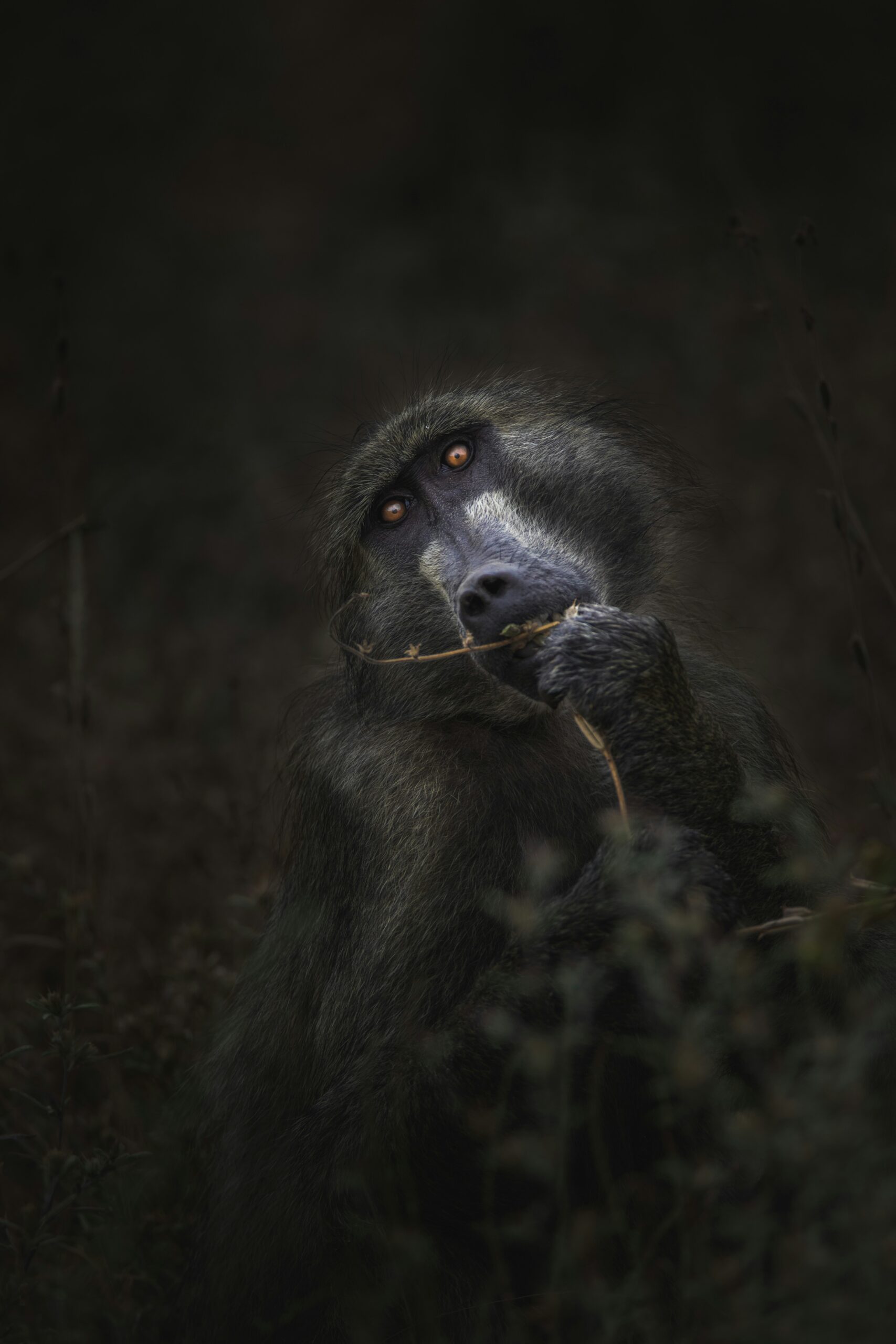
| Olive baboon | Dog-like muzzle, kinked tail, olive-tinted fur; up to about 85 cm long | Masai Mara, Nairobi National Park, Lake Nakuru, roadsides |
| Yellow baboon | Paler, yellowish coat, slimmer build | Amboseli, Tsavo and the coast |
| Blue (Sykes’) monkey | Grey coat that looks blue, white throat patch, round cheeks | Highland forests, Nairobi suburbs, Kakamega, the coast |
| Black-and-white colobus (guereza) | Black body, white face fringe and long white tail | Forests near water: Naivasha, Mount Kenya, Aberdare |
| Patas monkey | Long legs, reddish back, pale underside, white hair around a dark face | Laikipia, Baringo and Samburu savannah |
| Red-tailed monkey | White nose and cheeks, reddish tail | Kakamega Forest |
| Senegal bushbaby | Huge round eyes and ears, woolly grey-brown coat | Dry woodland, seen on night drives |
Vervet monkeys
The vervet is the commonest monkey in Kenya and the one that raids your table. Its voice is the interesting part: vervets have different alarm calls for different predators. One call means a leopard, another an eagle, another a snake, and the troop reacts to each by doing something different. Researchers working near Amboseli helped show this. Males have a famously bright blue scrotum, which our guides get asked about on almost every trip.
Baboons
Kenya has two main baboons. Olive baboons are the ones you see in the Mara and around Nairobi, in troops led by older males with females and young. Yellow baboons live in the south and east, around Amboseli and Tsavo. Both eat nearly anything, including scorpions they dig out from under stones, and leopards are their main predator. Treat them with respect: a large male has serious canines.
Colobus monkeys
The mantled guereza has a black body with a white face fringe and a long, white-tipped tail, and it is one of the most beautiful monkeys in Africa. Colobus eat leaves, which they digest in a multi-chambered stomach, and they have no thumbs. The Angola colobus has longer white fringes and a puffy white tail tip. On the coast near Diani, a conservation group protects colobus that are threatened by traffic and habitat loss.
Blue monkeys
Also called Sykes’ monkeys, these live in shaded, humid forest canopy near water. Some farmers kill them for eating crops, and forest clearance is shrinking their range.
Patas monkeys
The fastest primate on land, the patas is built like a sprinter, with long legs and a reddish back. The eastern patas lives in Laikipia, Baringo and Samburu and depends on whistling thorn woodland. The southern patas is now considered extinct in Kenya, with the last confirmed sighting near Amboseli in 2019.
Kenya’s rarest primates
- Tana River red colobus and Tana River mangabey. Both live only in the forests of the Tana River delta, and both rank among the world’s 25 most endangered primates. They are protected in the Tana River Primate Reserve, though the forests are shrinking as land is converted to farming.
- De Brazza’s monkey. Easy to recognise by its white beard and orange brow band. Fewer than 700 remain in Kenya, largely on the slopes of Mount Elgon.
- Mount Uarges guereza. Found only in the Mathews Range. A 2012 census counted around 400.
- Taita Mountain dwarf galago. Only about 6 km² of the indigenous forest of the Taita Hills remains, roughly 2 percent of the original.
- Mount Kenya potto. Not seen since 1946.
Bushbabies: the primates you hear first
Galagos are small, nocturnal and surprisingly loud. Kenya has two species commonly found on night drives and around lodges: the Senegal bushbaby in dry woodland, and the small-eared greater galago in highland and coastal forests. They leap like grasshoppers between branches and their huge eyes give them good vision in the dark. Join a night drive to see one. Our post on Kenya’s nocturnal animals explains where those are possible.
Where to see primates in Kenya
- Kakamega Forest. Red-tailed and blue monkeys, colobus and many birds. See the Kakamega Forest guide.
- Mount Elgon. De Brazza’s monkeys and colobus. See the Mount Elgon guide.
- Aberdare National Park. Forest monkeys and colobus. See the Aberdare guide.
- Laikipia and Samburu. Patas monkeys, vervets and baboons. See the Laikipia guide and the Samburu guide.
- Ol Pejeta Conservancy. A chimpanzee sanctuary for rescued animals. See the Ol Pejeta guide.
- Diani and the coast. Colobus, Sykes’ monkeys and bushbabies. See the Diani Beach guide.
- Amboseli, Masai Mara and Nairobi National Park. Baboons and vervets on almost every game drive.
Why Kenya’s primates are in trouble
Most of the threats come back to forests. Logging and farming clear habitat, roads and infrastructure cut it into fragments, and riverine forests are being converted to fields. Illegal pet trade and hunting for pelts add pressure. Climate change is making things worse, with droughts pushing herders into primate habitat, floods destroying riverine forests and erratic weather disrupting fruiting cycles. Visitor money helps: park fees and responsible tourism pay for rangers and forest protection. See our guide to responsible safaris.
How to behave around monkeys and baboons
- Never feed them. Fed monkeys lose their fear of people and end up being destroyed.
- Keep windows closed and food out of sight. Baboons can open car doors.
- Do not stare or show your teeth at a large male. Back away calmly.
- Close your tent or room door whenever you go out.
The rest of our etiquette advice is in safari dos and don’ts, and the overall wildlife picture is in the Kenya wildlife guide.
Inside a baboon troop
A baboon troop is a small society. Females stay in the troop they were born into and form long-term alliances and rivalries, while males leave at maturity and join other troops. Rank matters: a high-ranking female’s offspring get better food and protection. Researchers in Amboseli have followed individual baboons there for decades, which has made the park one of the best-studied baboon populations in the world. On a game drive you can watch grooming, which is how baboons mend relationships, and the sentries on high branches who give the alarm when a leopard is near.
Best time of day to watch primates
Early morning is best. Troops leave their sleeping trees or cliffs at first light, feed actively and groom in the sun. Colobus are most visible when they bask on the top branches at dawn. Bushbabies, by contrast, wake up after dark. Midday is quiet for most species, which is a good time for lunch.
Photography tips for monkeys
- Shoot at eye level when you can. The best portraits come from low angles.
- Use a fast shutter speed, because monkeys move constantly.
- Look for behaviour: mothers carrying babies, grooming, play.
- In forest, raise your ISO and use a longer lens. Our safari photography tips explain how.
Can you do a primate-focused trip in Kenya?
You can, and it is a great way to see parts of Kenya that most visitors miss. A western circuit could include Kakamega Forest for red-tailed and blue monkeys and colobus, Mount Elgon for De Brazza’s monkeys and the Aberdares for forest primates. The Tana River Primate Reserve is remote and needs specialist planning. Many travellers add primate time to a wider trip with Samburu and Laikipia. Ask us and we will map a route.
Frequently asked questions
How many primate species are in Kenya?
About 25 species, including baboons, guenons, colobus monkeys, patas monkeys, mangabeys and galagos. Roughly half are threatened.
What is the most common monkey in Kenya?
The vervet monkey, which lives along rivers and in woodland across the country.
Where can I see colobus monkeys in Kenya?
Black-and-white colobus live in forests near Lake Naivasha, Mount Kenya, the Aberdares and Kakamega. Angola colobus live on the south coast near Diani.
Are there gorillas or chimpanzees in Kenya?
Not in the wild. Kenya has a chimpanzee sanctuary for rescued animals at Ol Pejeta. Gorilla trekking is done in Uganda and Rwanda.
Which Kenyan primates are most endangered?
The Tana River red colobus and Tana River mangabey, found only in the Tana delta, are among the 25 most endangered primates in the world.
Is it safe to feed monkeys?
No. Feeding makes them aggressive and dependent on people, and it is discouraged in all parks.
Want to see the rarest Kenyan monkeys on safari? Talk to our team and we will plan the route.