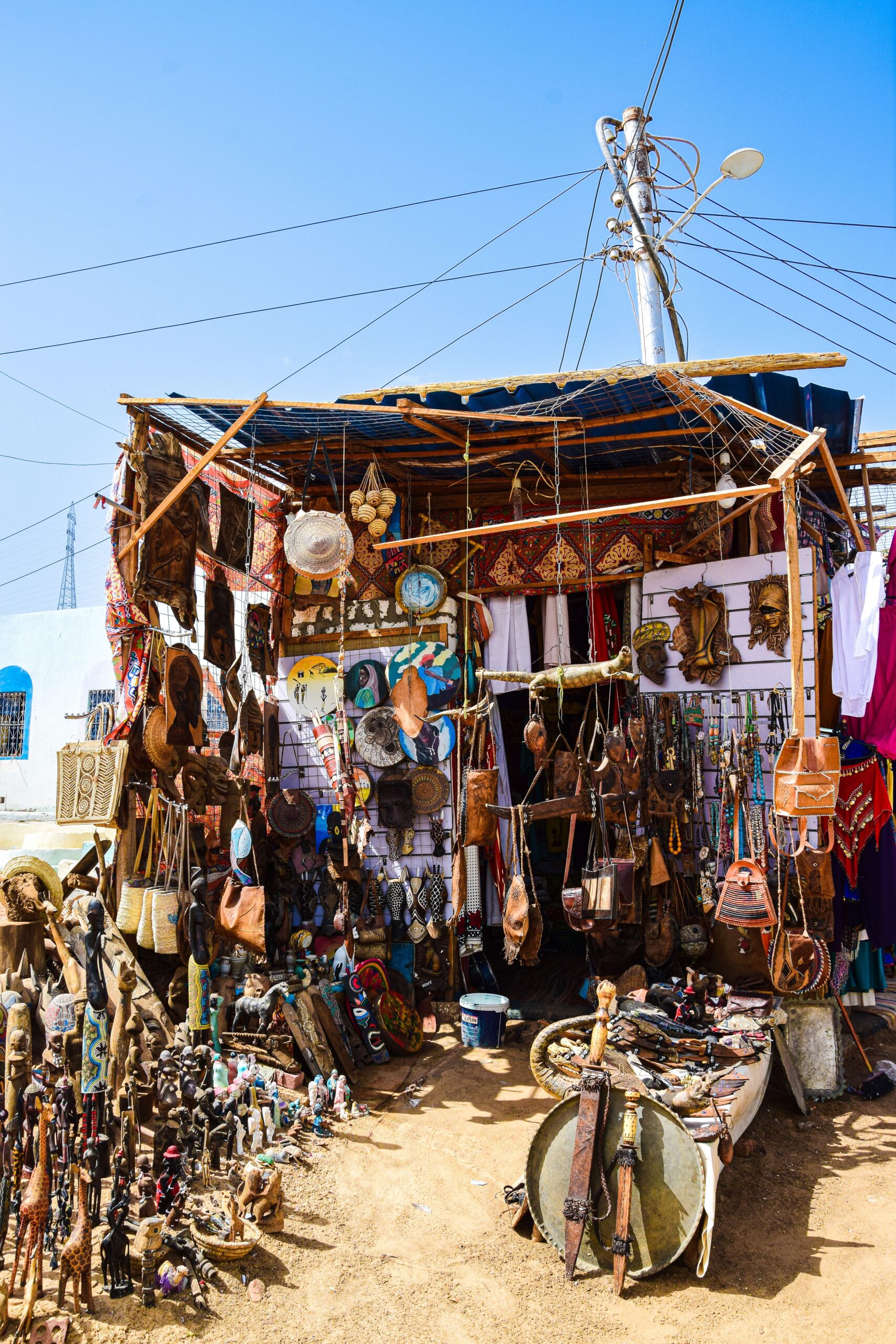
Every year, thousands of visitors leave Kenya with a camera full of lions and a suitcase full of regret: a “hand-carved” mask that turns out to be moulded resin, a shuka that cost three times the going rate, a pile of bracelets they will never wear. Kenya souvenirs are some of the best on the continent, but only if you know what is genuinely made here, who makes it and what a fair price feels like. This guide covers all of it, from the Maasai Market in Nairobi to the Kazuri bead workshop in Karen.
The best Kenya souvenirs worth packing
If you are wondering what to buy in Kenya, start with what you will actually use when you get home. These are the Kenya souvenirs our guests keep asking us about.
Kiondo baskets
The kiondo is a woven carryall with leather straps, traditionally made from sisal. A good one is tight and even, holds its shape when you lift it by the handles and has no loose ends poking out. Check the stitching where the leather meets the weave, because that is where cheap ones fail first. It is the most useful thing on this list: it works as a beach bag, a market bag and a handbag.
Maasai shukas
The shuka is the cotton wrap you see on Maasai herders across the Mara and Amboseli. It is traditionally red and plaid, and it replaced the cattle hides that earlier generations wore. Red dominates at most stalls, but you will also find blue and green versions. Buy one as a throw, a picnic blanket or a scarf. It folds small and washes well.
Beadwork
Maasai and Samburu women make the bracelets, collars and beaded sandals sold across Nairobi. Look for even stitching, beads that sit flat and clean finishing on the back. Bracelets in the red, black and green of the Kenyan flag are popular and easy to pack. If a stall holds up a “wedding collar” for a very low price, it is probably machine-made.
Kazuri ceramic beads
Kazuri means “small and beautiful” in Swahili. The workshop in Karen, on the edge of Nairobi, was founded in 1975 by Lady Susan Wood and now employs more than 400 people, most of them women, including single mothers and widows. Every bead is rolled, painted and fired by hand. Kazuri sells to customers in about 30 countries, so you may even recognise a necklace back home, but buying at source means you see how they are made. The shops at Westgate and Village Market stock the same range.
Akamba woodcarvings and Kisii soapstone
The Akamba community is famous for carved animals, masks, bowls and utensils. The Akamba Handicraft Industry Cooperative runs a large store and open-air workshop near the airport in Mombasa where you can watch the carvers, and it can ship big pieces. Soapstone from the Kisii area is softer and cooler to the touch. Real soapstone scratches with a fingernail, whereas plastic does not. Ask what the wood is and turn each piece over: hairline cracks on the underside mean it has not been seasoned properly.
Kikoy and kanga
These cotton wraps are coastal staples. A kikoy is thicker and fringed, a kanga is lighter and printed with a Swahili proverb along the border. Both dry fast and fold flat, which makes them ideal if you are also planning a few days on the coast. Our Diani Beach guide covers where to buy them there.
Kenyan coffee and tea
The easiest gift to carry. Buy whole beans in a sealed foil bag and check the roast date. Kenyan coffee is bright and fruity, and the grades you will see on the bag (AA, AB and PB for peaberry) describe bean size rather than quality.
Where to shop: the Maasai Market and the alternatives
The Maasai Market is not a single place. It is a rotating open-air craft market that sets up in a different Nairobi location each day, usually from about 8am to 5.30pm. It is closed on Mondays. The schedule below is the usual rotation, but locations shift when malls rearrange their parking, so ask your driver-guide on the day. If you are on one of our tours, we do this for you.
| Day | Location |
|---|---|
| Monday | Closed |
| Tuesday | Kijabe Street, opposite the Norfolk Hotel (moved from Westgate, Westlands) |
| Wednesday | Capital Centre, Mombasa Road |
| Thursday | Junction Mall, Ngong Road |
| Friday | Village Market, Gigiri (upper car park) |
| Saturday | High Court parking lot, city centre |
| Sunday | Yaya Centre, Hurlingham |
For a first visit, Friday at Village Market and Sunday at Yaya Centre are the easiest. They sit in comfortable parts of town, and a lot of travellers go, so no single seller leans on you. Saturday at the High Court lot is the biggest, and also the most crowded. Weekday mornings are calmer than weekends.
If you hate bargaining
Go to a fixed-price shop. The Zanzibar Curio Shop on Moi Avenue has price tags, and plenty of visitors use it as a benchmark before heading to the market. The Nairobi National Museum gift shop has a small but high-quality selection, and the Kazuri shops are fixed-price too. You pay a little more, you get a receipt and you skip the negotiation. That is a fair trade for some people.
How to bargain at the Maasai Market without the stress
- Treat the first price as an opening line. Nothing is priced and everything is negotiable. A counter-offer of around half is normal, and you usually settle somewhere in between.
- Look at two or three stalls first. The same shuka or bracelet appears across the market, so you will quickly learn the range.
- Ask for what is not on display. Vendors often keep their best pieces back. If you want a specific colour or size, ask.
- Try sandals on. Sizes vary a lot between makers.
- Bundle. Buying several items from one stall is where real discounts happen.
- Know when to stop. If a seller will not move, you have reached their floor. Paying the asking price on a small item is better than grinding for an extra fifty shillings.
- Beware of “gifts”. A bracelet pressed into your hand turns into an expectation. Say a friendly “no, thank you” before you take it.
Bring Kenyan shillings in small notes, because many stalls cannot change large ones. Some accept cards or mobile money, but cash is the safest. For more on money and mobile data, see our guides to Kenya currency and M-Pesa for visitors.
Safety and common sense
The Maasai Market is generally safe for visitors, with normal city precautions. Leave expensive jewellery and watches at the hotel. Keep your phone and wallet in a front pocket or zipped bag. Going with your safari guide helps with prices and with knowing which stalls are worth a stop.
What not to buy: souvenirs to avoid in Kenya
Anything made from animal parts. Ivory, skins, shells and coral are illegal to export and will be confiscated at the airport, and buying them feeds the same poaching that conservation money is trying to stop. If a stall offers “bone” or “ivory” carvings, walk on. Genuine carvings are wood, soapstone or recycled metal. Be careful with “antique” masks too, because many are made recently and aged to look old. You can read more about where your money goes in our guide to responsible safaris and community conservancies.
Getting your Kenya souvenirs home
Wrap carvings in clothes in your checked bag, and keep glass and ceramics in your hand luggage if you can. Some countries restrict untreated wood, so ask for finished and varnished pieces. Beads, textiles and baskets travel with no trouble. If you buy something big, the Akamba cooperative and larger shops will ship it.
A simple shopping plan for one Nairobi afternoon
If you only have a free afternoon for souvenir shopping in Nairobi before your flight, do Kazuri in the morning, then the Maasai Market that matches the day of the week. Ask your driver to wait nearby so you are not carrying bags around town. If you have more time, the Karen Blixen Museum and the Giraffe Centre are both close to Kazuri, and our things to do in Nairobi guide shows what else fits around shopping. For longer stays, read our Nairobi stopover guide.
Frequently asked questions
Is the Maasai Market open every day?
No. It rotates between locations from Tuesday to Sunday and is closed on Mondays.
What are the best souvenirs to buy in Kenya?
Kiondo baskets, Maasai shukas, beadwork, Kazuri ceramic beads, soapstone and wood carvings, kikoy wraps and Kenyan coffee. All are made in Kenya and pack well.
Can I use US dollars at the Maasai Market?
Some sellers accept dollars but the exchange rate they give is usually poor. Kenyan shillings in small notes get you better prices.
How do I know if a carving is real wood or soapstone?
Soapstone is cool, smooth and will scratch with a fingernail. Real wood has a visible grain and no moulded seams. Turn the piece over and check the base.
Where can I buy souvenirs at a fixed price?
Kazuri in Karen, the Zanzibar Curio Shop on Moi Avenue and the Nairobi National Museum gift shop all have price tags.
What can I not take out of Kenya?
Ivory, animal skins, shells and coral. They are illegal to export and customs will confiscate them.
Planning a Kenya trip? Talk to our team and we will build Nairobi shopping into your safari itinerary.