On your first game drive everything with four legs and horns looks like the same brown deer. By day three you are arguing with your guide about whether that was a topi or a hartebeest. Kenya has more than 25 species of antelope and gazelle, from the dik-dik, which stands barely a foot high, to the eland, which weighs about half a ton. This field guide to the antelopes in Kenya shows you how to tell them apart, where each one lives and which are in real danger.
Antelope or gazelle? A quick answer
All gazelles are antelopes, but not all antelopes are gazelles. “Antelope” is a broad group of hoofed animals with permanent, unbranched horns. Gazelles are a smaller, lighter branch of it, built for speed. In practice, if it is small, fawn-coloured with a white rump and a dark side stripe, it is probably a gazelle. If it is bigger, with a different shape, it belongs to another group. You do not need the biology, only the clues below.
The plains antelopes you will see every day
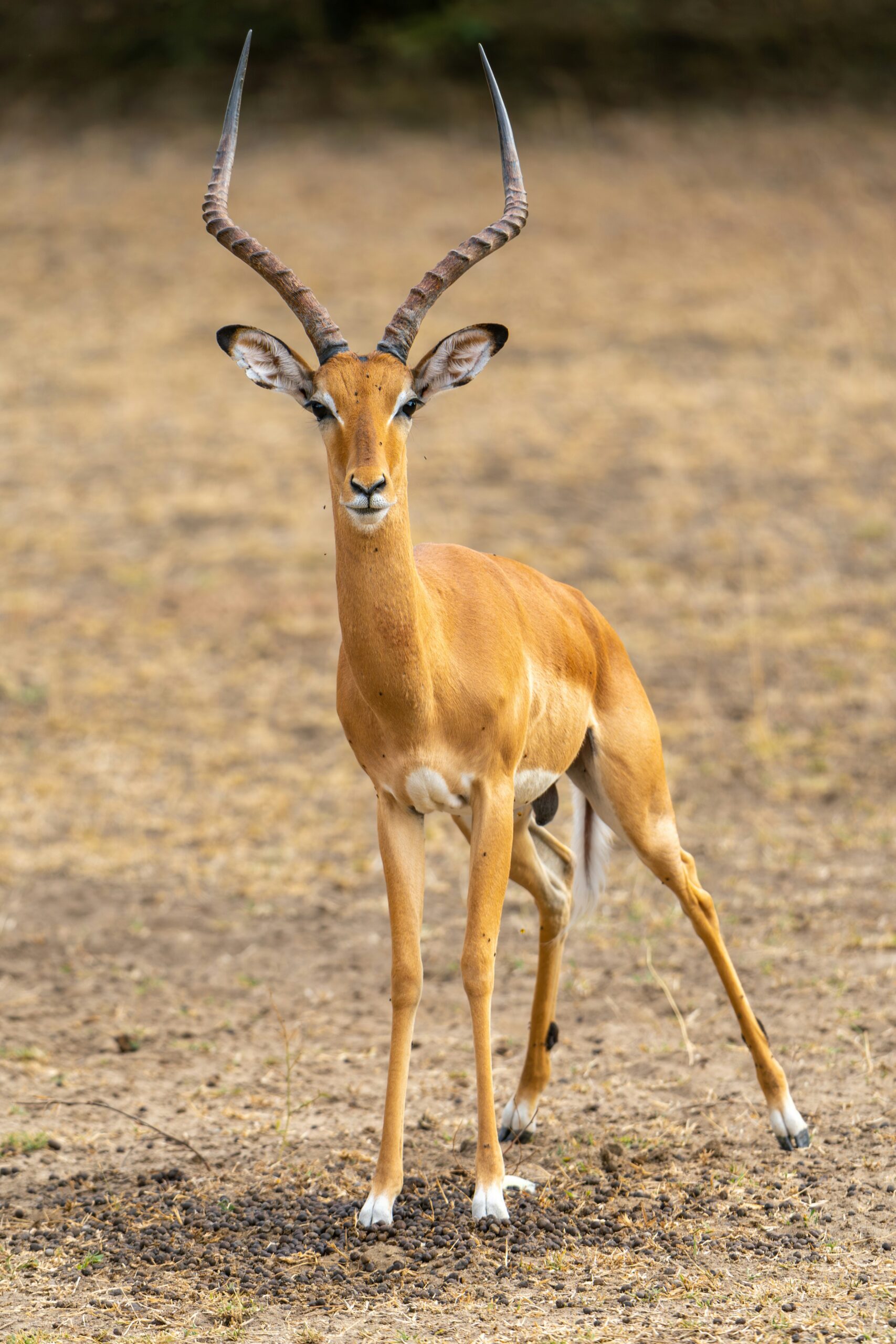
Impala
The commonest antelope on safari. Slender, russet and graceful, with black vertical stripes on the white rump, which guides jokingly call the McDonald’s “M”. Only males carry the lyre-shaped horns. Impala live in herds and leap enormous distances when alarmed.
Topi
Glossy red-brown with dark patches on the face and upper legs, and often seen standing on termite mounds as lookouts. Topi are fast and thrive on grassland, and they are a Masai Mara highlight.
Coke’s hartebeest (kongoni)
A lighter brown, long-faced antelope with bracket-shaped horns and steeply sloping hindquarters. It looks a bit like it is walking downhill. Always alert and with plenty of stamina.
Wildebeest
Grey, bearded, with buffalo-like horns and a shaggy mane. Herds of hundreds gather on the plains, and in the Mara millions follow the rains. They can live up to 40 years and walk roughly 1,000 km a year. See our Great Migration guide.
Thomson’s and Grant’s gazelles
Thomson’s gazelle (“Tommy”) is smaller and brighter, with a black band along each flank and a constantly twitching tail. Grant’s is bigger with a white rump that extends up the back, a chestnut face streak and long, lyre-shaped horns that can reach about two feet. Thomson’s has a habit of “pronking”, leaping straight up with all four legs. It is a warning to predators and it is spectacular to watch.
Antelopes that live near water
- Waterbuck (kuro). Shaggy grey-brown coat. The Defassa variety has a solid white rump, while the common waterbuck has a white ring. Herds of 8 to 30 are led by one male.
- Bohor reedbuck (tohe). Yellowish-brown, white belly, horns hooked forward at the tips. Found in open country with reeds and tall grass.
- Bushbuck (mbawala). A shy forest antelope that relies on forest cover. Often seen alone or in pairs at dawn.
- Sitatunga (nzohe). A swamp specialist with long, splayed hooves. When frightened it submerges until only its face shows. You need a swamp like Saiwa to see one.
Antelopes of the dry north
Gerenuk
Swahili name swala twiga, the giraffe-gazelle. Long neck, long legs and the habit of standing on its hind legs to browse acacia leaves. A Samburu speciality. See our Samburu guide.
Beisa oryx (choroa)
Straight, long horns that bend slightly backward and a four-foot height. It copes with semi-desert and can survive on very little water.
Kirk’s dik-dik (suguya)
One of the smallest antelopes, barely over a foot tall, with a long, flexible nose. They live in pairs and are faithful for life. The name is thought to come from the sound of their alarm call.
Lesser kudu (tandala)
A smaller, slimmer kudu with no throat beard and more white stripes. It lives in dense thorn bush in the north and east.
The big ones
- Eland (mbunja). The largest antelope in Kenya, nearly six feet at the shoulder and about half a ton, with spiral horns and a tendency to jump high fences with ease.
- Greater kudu (tandala kubwa). Long spiral horns on males, a beard along the throat and vertical white stripes.
- Roan antelope (korongo). About five feet at the shoulder, red-brown with a black-and-white face and backward-curving ringed horns on both sexes.
- Sable antelope (palahala). Glossy black-brown males with huge, scimitar-shaped horns. Found mainly at Shimba Hills on the coast. See the Shimba Hills guide.
Small antelopes of bush and rock
- Steenbok and oribi. Small, reddish and solitary or paired. The oribi has dark glands under its ears and horns that angle backward.
- Klipspringer (ngurungu). Lives on rocky outcrops and walks on the tips of its hooves. Its coarse grizzled coat cushions falls.
- Duikers. Shy forest antelopes. The yellow-backed duiker, with its triangle of yellow hair on the back, is found in small numbers in the Mau Forest.
The rarest antelopes in Kenya
This is where the story turns serious. The 2025 national wildlife census, which ran from June 2024 to August 2025, counted only a few hundred of some species.
| Species | Census count | Where |
|---|---|---|
| Hirola | 245 | North-east Kenya, along the Tana River |
| Mountain bongo | 176 | Aberdares, Mount Kenya, Mau forests |
| Sable antelope | 40 (down from 51) | Shimba Hills |
| Roan antelope | 21 | Ruma and western Kenya |
The hirola, or Hunter’s hartebeest, is one of the world’s rarest antelopes. The bongo, with its mahogany-red coat and white stripes, is the largest forest antelope and is mostly active at night. Read the full story in our breakdown of the Kenya wildlife census.
Where to see antelopes in Kenya
- Masai Mara: topi, Thomson’s and Grant’s gazelles, impala, eland, wildebeest and hartebeest. See our Mara guide.
- Samburu and Laikipia: gerenuk, Beisa oryx, Grant’s gazelle, dik-dik and lesser kudu. See the Laikipia guide.
- Amboseli and Tsavo: eland, gerenuk, impala and waterbuck. See the Tsavo guide.
- Lake Nakuru: waterbuck, impala and Rothschild’s giraffe alongside the flamingos. See the Nakuru guide.
- Aberdare: bongo and bushbuck in the forest. See the Aberdare guide.
Tips for spotting and photographing antelopes
Look at the rump first, then the horns, then the face. Early morning and late afternoon are best, when herds move to water. Predators follow antelope herds, so a nervous group of impala often means a leopard or lion nearby. For camera advice, read our safari photography tips, and for the whole wildlife list see the Kenya wildlife guide.
Five questions to identify any antelope
- How big is it? Dik-dik and steenbok are tiny, gazelles are mid-sized, and eland and kudu are huge.
- What is on the rump? A white heart with black stripes is impala, a white patch reaching the back is Grant’s, a ring is common waterbuck, and a full white patch is Defassa.
- What do the horns look like? Lyre-shaped (impala, gazelles), bracket-shaped (hartebeest), spiral (kudu, eland), scimitar (sable, oryx) or hooked (reedbuck).
- What is the habitat? Reeds and water, rocky outcrops, dense forest or open plains narrow the list immediately.
- Is it alone, in pairs or in herds? Dik-dik and steenbok are solitary or paired, impala and topi form herds.
Behaviour worth watching for
- Topi on termite mounds. Males stand on mounds to guard patches of grassland and attract females.
- Impala herds in the dry season. Males hold harems and defend them noisily.
- Thomson’s gazelle “pronking”. Stiff-legged bounding is a signal to predators that the gazelle is fit and will not be easy to catch.
- Eland as a barometer. They are shy and move off early. Seeing one near the road means a quiet spot.
- Predators close by. Alarm calls, frozen herds and all heads turned the same way mean a cat nearby.
Antelopes and the Great Migration
The Migration is mostly wildebeest and zebra, but Thomson’s gazelles and eland travel with the herds, and topi and hartebeest wait on the Mara side. Their grazing patterns shape the plains for every other species. For dates and river crossings, read our Great Migration guide.
Which parks give the best antelope variety?
Samburu gives you the dry-country specials: gerenuk, Beisa oryx, Grant’s gazelle, dik-dik and lesser kudu. The Mara gives you the plains animals in huge numbers. Laikipia offers both, plus rarer visitors like greater kudu and eland. For a first safari, combining Samburu and the Mara usually gives the most variety. Talk to us about safari packages that include both.
Frequently asked questions
How many antelope species are in Kenya?
More than 25 species of antelope and gazelle, ranging from the tiny dik-dik to the half-ton eland.
What is the difference between a topi and a hartebeest?
A topi is glossy red-brown with dark face and upper-leg patches and stands on termite mounds. Coke’s hartebeest is lighter brown, longer faced and has a steeply sloping back.
How do I tell Thomson’s gazelle from Grant’s?
Thomson’s is smaller, has a black stripe along each side and a twitching black tail. Grant’s is larger, with a white rump that reaches up the back and longer horns.
Which antelope is the rarest in Kenya?
The hirola, with 245 counted in the 2025 national wildlife census, is among the rarest. Roan antelope (21) and sable antelope (40) are also critically low.
Where can I see gerenuk in Kenya?
Samburu National Reserve and the surrounding northern conservancies are the best places.
Want a safari built around Kenya’s wildlife? Talk to our team.