
The Great Migration in Kenya: When to See the Mara River Crossings
Almost every article on this topic quotes the same two things: “July to October” and “1.3 million wildebeest.” One of those is a reasonable starting point. The other, it turns out, is a number that new research is actively questioning — and it’s worth knowing about before you plan a trip around it. Here’s the honest, cross-checked version: when the migration is genuinely in Kenya, what a crossing actually looks like once you’re there, and why the population figure most blogs still quote deserves a second look.
When Is the Great Migration in Kenya?
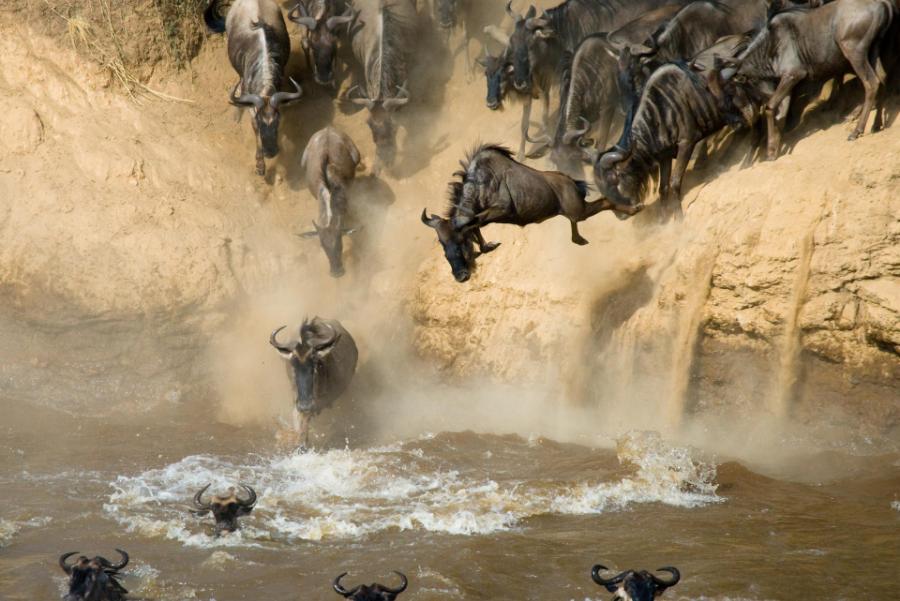
Broadly, the herds are present in the Maasai Mara from around May through October, but the two headline river crossings — the ones people actually mean when they say “the migration” — cluster more narrowly. The African Wildlife Foundation describes the northward movement into Kenya as picking up through the year as herds chase fresh grazing, with the animals eventually returning south along the same general corridor (African Wildlife Foundation). The Narok County Council’s own management plan for the Maasai Mara National Reserve is more specific about the crossing window itself, noting that a smaller northern migration mixes with the main herds in the reserve specifically between July and September — the period when Mara River crossings become “world famous” visitor draws (Maasai Mara National Reserve Management Plan, Narok County).
The honest caveat, worth repeating every year rather than treating as fine print: the herds move by rainfall, not by calendar, and the exact week a crossing happens at any given point on the river can shift by several weeks in either direction. Nobody, including us, can promise you a crossing on a specific date.
Where Do the River Crossings Actually Happen?
The Mara River is the main event, and for a specific ecological reason rather than just tradition: it’s described in the reserve’s own management plan as “the only perennial river in the Mara-Serengeti Ecosystem” — meaning it’s the one water source in the entire ecosystem that never dries up, which is exactly why hundreds of thousands of animals funnel toward it rather than dispersing to smaller seasonal streams (Maasai Mara National Reserve Management Plan, Narok County). The river cuts through the reserve and the adjoining Mara Triangle, and crossing points shift year to year depending on water levels and where the herds happen to be moving, rather than sitting at one single fixed spot.
How Many Wildebeest Are Really in the Migration?
This is where it’s worth slowing down, because the figure almost every safari website repeats is being actively re-examined by scientists right now. For decades, the accepted number — from traditional light-aircraft aerial surveys — has held steady at roughly 1.3 million wildebeest, and Tanzania’s own Wildlife Research Institute reaffirmed that figure as recently as 2023 (Africa Geographic).
In September 2025, a research team led by Dr. Isla Duporge published a very different result in the peer-reviewed journal PNAS Nexus. Using AI-trained deep-learning models applied to high-resolution satellite imagery covering thousands of square kilometers of the Serengeti-Mara ecosystem, the team counted somewhere between roughly 324,000 and 533,000 wildebeest across the 2022 and 2023 surveys — less than half the long-accepted number (Discover Wildlife / BBC Wildlife).
To be clear about what this does and doesn’t mean: the researchers themselves stopped well short of declaring a population collapse. Africa Geographic’s coverage of the same study notes the authors flagged several possible explanations that have nothing to do with an actual decline — differences in survey timing and geographic coverage between the two methods, herds spreading across a wider area than older surveys captured, and even the possibility that the AI occasionally mistook zebra or eland for wildebeest at the imagery’s 30-centimeter resolution (Africa Geographic). The researchers’ own conclusion, echoed in both independent write-ups of the study, is that this discrepancy calls for more research using multiple counting methods together — not that the older figure or the newer one is simply wrong.
What this means practically for you as a safari traveler: the migration you’ll see is still the same genuine, massive spectacle it’s always been. But if you read “1.3 million wildebeest” on a competitor’s website presented as an unquestioned fact, know that as of 2025 that number is under real scientific scrutiny, not settled science.
Is the Migration Getting Harder to Predict?
Somewhat, yes, and it’s worth setting expectations around this honestly rather than promising precision no operator can deliver. The African Wildlife Foundation notes that climate change has already altered migration dynamics, causing real delays to the herds’ movements in recent years, on top of the usual year-to-year variability driven by rainfall (African Wildlife Foundation). The same source points out a detail worth knowing if you’re the kind of traveler who likes the bigger picture: around 60% of Kenya’s wildlife lives outside formally protected areas entirely, moving instead through community lands and private ranches — which means migration corridors well beyond the Mara’s official boundary matter just as much to the herds’ long-term survival as the reserve itself.
What’s a Crossing Actually Like to Watch, Honestly?
Busier than most brochure photos suggest, and it’s worth knowing this before you go rather than being surprised by it. The reserve’s own management plan is candid about this: it records that more than 150 vehicles have sometimes been counted at a single crossing point during peak periods, and it specifically flags “intense visitor pressure at key times of year” as something the reserve is actively working to manage better through zoning and visitor controls (Maasai Mara National Reserve Management Plan, Narok County).
That’s a genuinely useful thing to know before you book: the classic empty-savanna, one-vehicle-and-a-thousand-wildebeest photo you’ve seen online is real, but it isn’t guaranteed at the most famous crossing points during the busiest weeks of peak season. A good guide who’s willing to wait at a quieter crossing point, or to time your visit for the edges of the July-September window rather than its absolute peak, makes a genuine difference to the experience — and it’s a fair question to ask any operator, including us, before you commit to dates.
Can You See the Migration Outside July-September?
Yes, and it’s an underrated option. Outside the peak crossing window, the Maasai Mara is still home to enormous resident herds of wildebeest, zebra, and plains game that never leave, along with the Mara’s famously dense predator population — you’re trading the specific river-crossing spectacle for noticeably fewer vehicles and lower rates. our Maasai Mara vs Amboseli vs Tsavo post goes into how the Mara compares to Kenya’s other major parks if the migration itself isn’t the only factor in your decision.
So When Should You Actually Book?
If seeing an actual river crossing is the priority, aim for July through September, and build in flexibility — a 4-5 night stay gives your guide room to reposition if the herds are running early or late that year. If you’d rather have the Mara’s resident wildlife and predators with far fewer other vehicles around, the shoulder months outside that window are a genuinely strong alternative, not a consolation prize. Either way, treat any specific date promise — from us or anyone else — with appropriate skepticism; this is wildlife, not a scheduled performance.
Tell us your travel dates and how much flexibility you have, and we’ll tell you honestly what your odds actually look like that year, before you book anything.
Frequently Asked Questions
What is the best month to see the wildebeest migration in Kenya? July through September is the most reliable window for Mara River crossings specifically, according to the reserve’s own management plan, though the exact timing shifts with rainfall each year.
How many wildebeest are actually in the migration? The traditional figure, from decades of aerial surveys, is about 1.3 million. A 2025 peer-reviewed study using AI and satellite imagery counted roughly 324,000-533,000, and the researchers themselves say more study is needed to explain the gap — it isn’t yet clear whether this reflects an actual decline or a difference in counting method.
Is the Mara River the only place to see a crossing? It’s the main and most famous crossing point, and the reserve’s management plan describes it as the only perennial river in the entire ecosystem, which is exactly why the herds concentrate there rather than spreading to smaller streams.
Are river crossings crowded with tourist vehicles? Often, yes, at the most famous crossing points during peak weeks — official reserve documentation records more than 150 vehicles at a single crossing during busy periods. A guide willing to seek out quieter crossing points can make a real difference.
Is it worth visiting the Maasai Mara outside the July-September migration window? Yes — the Mara has enormous resident wildlife populations and dense predator activity year-round, and outside peak migration season you’ll generally see far fewer other vehicles and pay less for camps.
Written by Francis Cherish, Founder of Cherish Africa Safaris. Want an honest read on your odds for your specific dates? Get in touch and we’ll tell you what to actually expect before you book.