Most people fly into Nairobi, spend a night, and head out to the Mara. They never see the forest sitting five kilometres from the city centre, ringed by embassies and some of the capital’s most expensive houses. Karura Forest is about 1,000 hectares of indigenous trees, bamboo, rivers and a waterfall, and you can walk through it in sneakers on the afternoon you land. It is also one of the best answers to the question, “What do I do in Nairobi before my safari?”
What is Karura Forest?
Karura is an urban forest run by the Kenya Forest Service (KFS) together with the Friends of Karura Forest, a community group that helped turn it from a neglected, unsafe patch into one of Nairobi’s most popular outdoor spaces. The forest comes in two blocks: the main forest of roughly 710 hectares, and the Sigiria block near Gigiri, about 250 hectares. A third area, the Karura Picnic Grounds, sits across Kiambu Road.
Its story is part of its appeal. In the 1990s, parts of the forest were being allocated to private developers, and Nobel Peace Prize winner Wangari Maathai and a coalition of activists campaigned to stop it. The main route through the forest is named after her: the Wangari Maathai Track runs from Gate C to Wangari’s Grove. You do not need to know any of that to enjoy the walk, but it gives the forest a weight most city parks lack.
What to see and do in Karura Forest
The waterfall and caves
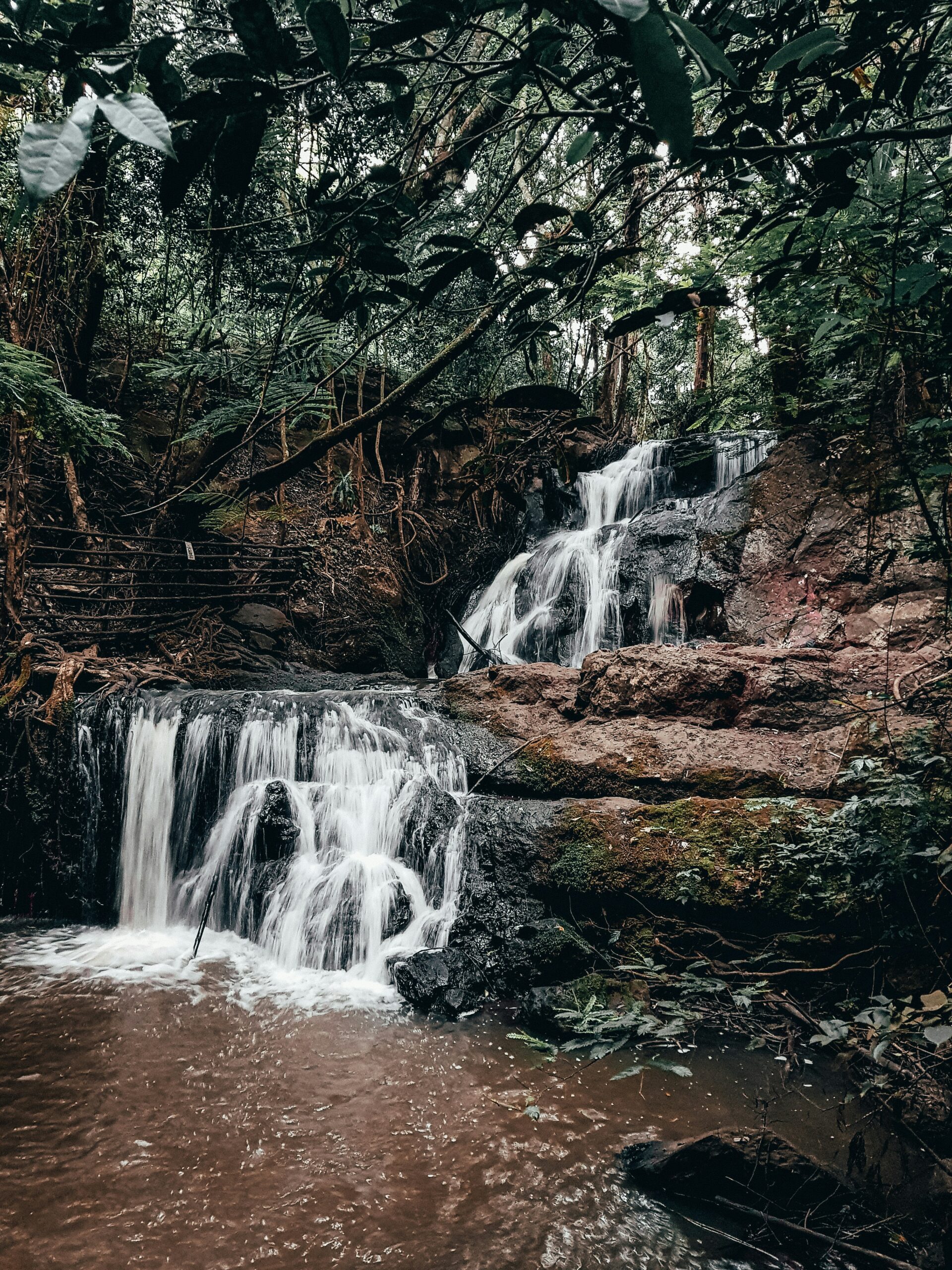
The most popular walk leads to Karura Waterfall, a drop of roughly 50 feet that spills over three shelves before settling into a quiet river. Near the falls are caves that local communities regarded as sacred and that are reputed to have sheltered Mau Mau fighters during the independence struggle. The signed “Waterfall and Caves Circuit” is about 4 km and takes roughly two hours at a gentle pace. The path starts on wide dirt tracks and narrows to a steep trail near the river, so wear shoes with grip.
Walking, jogging and cycling
There are more than 50 km of marked trails. Walkers and joggers can choose between short loops and long, quiet routes. Named trails include the Wangari Maathai Track, the Muhugu Trail, the Mau Mau Trail, the Family Trail, the Turaco Path and the Lake Trail. Cyclists have the Bicycle Trail, and a sign warns that bikes are not allowed on Shady Path. Bike hire is listed at about KES 500 per hour.
Horse riding
Riding is available from the Sigiria entrance at around KES 290. It is a gentle introduction if you plan to try a riding safari later in your trip.
Wildlife and birds
You will not see lions. What you can expect is Sykes’ monkeys in the canopy, bushbuck and duikers in the undergrowth, squirrels and a good variety of birds, including turacos, weavers, hornbills and birds of prey. Early morning is the best time. For a longer list of places to look for birds in Kenya, read our birdwatching guide.
Picnics, quiet corners and the old chimney
Lakes and ponds, including the Butterfly Pond and Lily Lake, are favourite stops for a picnic. The forest also hides an old chimney incinerator that the Central Bank of Kenya once used to burn withdrawn banknotes. Picnic sites need to be booked in advance for a fee.
Karura Forest entrance fees (2026)
Entry is charged per person, per day, and tickets are valid only on the day of issue. Children are under 13.
| Visitor | Adult (KES) | Child (KES) |
|---|---|---|
| Kenyan citizen | 116 | 58 |
| Kenya and East African resident | 232 | 116 |
| Non-resident | 696 | 348 |
Extra charges apply for parking (KES 232 for a car, KES 464 for a minivan), for horse riding (KES 290), for a two-hour guided walk (KES 348) and for photo shoots. Filming and events must be arranged in advance, and drones are not allowed.
Opening hours and getting there
The forest is open daily from about 6am to 6pm, and tickets usually stop selling around 5.30pm. Gate C is on Kiambu Road, Gate A on Limuru Road and the Sigiria entrance is near the Gigiri diplomatic area. You can reach the gates by taxi in 20 to 40 minutes from most central Nairobi hotels, depending on traffic. Matatus heading toward Kiambu drop you near Gate C. If you are going with us, your driver-guide takes you straight to the gate and waits.
Rules and etiquette
- Stay on the marked tracks.
- Take your litter with you. Single-use plastics are discouraged.
- Do not feed or disturb wildlife, and do not pick plants.
- Dogs must be registered, vaccinated and on a lead outside off-leash areas.
- No smoking, fires, loud music or drones.
- Children under 12 must be accompanied by an adult.
Is Karura Forest safe?
It is generally regarded as one of the safer public recreation spaces in Nairobi. There are controlled entry points, patrols and staff, and the trails are well-marked and busy on weekends. As in any city park, go in daylight, keep valuables out of sight and avoid walking quiet trails alone late in the day. A guide is optional, but it helps if you want to understand the history.
Best time to go and how long to allow
Go early on a weekday morning for the best light and fewest people. Weekends are lively with joggers, families and cyclists. After rain the waterfall is at its best, but trails get slippery. Allow two to three hours for the waterfall circuit, or half a day if you want to cycle, picnic and wander.
Combine it with other Nairobi stops
Karura sits close to Gigiri, so it pairs easily with the Friday Maasai Market at Village Market (see our Kenya souvenirs guide). A full day could also include the Giraffe Centre, the David Sheldrick Elephant Orphanage and the Karen Blixen Museum. Our guides to things to do in Nairobi and the Nairobi stopover show how to fit them around your flights.
A short history of Karura
The forest was gazetted as a protected area decades ago, but by the 1990s parts had been allocated to developers, and its edges were being cut away. Wangari Maathai and other campaigners resisted, and the struggle became a symbol of the wider fight over public land in Kenya. Over time a fence, patrols and the work of the Friends of Karura turned the forest into the safe, popular space you see today. Walking its trails is a way to see what community conservation can achieve in the middle of a capital city.
Three ways to spend your time in Karura
A two-hour waterfall walk
Enter at Gate C, follow the signs for the Waterfall and Caves Circuit and allow about two hours with photo stops. It is an easy family walk until the last section, which narrows and drops to the river.
A half-day bike ride
Hire a bike at the gate, follow the Bicycle Trail and add the Wangari Maathai Track. Cyclists are not allowed on every path, so follow the signs. Allow three to four hours with a picnic.
An early birding walk
Arrive when the gate opens at about 6am. Turacos, hornbills, weavers and birds of prey are most active in the first hours of the day, and the paths are quiet. A guide helps you find them.
What to bring
- Comfortable shoes with grip. Trails are slippery after rain.
- Water, a hat and sunscreen. The sun is strong in the open sections.
- Insect repellent in the wet season.
- Small notes for tickets, parking and snacks.
- A light rain jacket from March to May and in November.
Is it worth it if you only have one day in Nairobi?
If you only have a day, Nairobi National Park, the Giraffe Centre and the Elephant Orphanage give you wildlife encounters that Karura cannot match. But if you have a morning free, are travelling with someone who dislikes vehicles, or simply want to stretch your legs after a long flight, Karura is hard to beat. It costs a fraction of the big attractions, and it shows you a side of Nairobi that most visitors miss.
Frequently asked questions
How much is the Karura Forest entrance fee for tourists?
Non-resident adults pay KES 696 and children KES 348. Parking, horse riding and guided walks cost extra.
What are Karura Forest’s opening hours?
Daily from about 6am to 6pm. Tickets usually stop selling at about 5.30pm.
How long does it take to walk to Karura waterfall?
The waterfall and caves circuit is about 4 km and takes around two hours at an easy pace.
Can you cycle in Karura Forest?
Yes. There are marked cycling trails and bikes can be hired at about KES 500 per hour.
Are there animals in Karura Forest?
Yes: Sykes’ monkeys, bushbuck, duikers and plenty of birds. There are no big predators.
Is Karura Forest safe for tourists?
Generally yes, in daylight and on the busier trails. It has controlled gates, patrols and trained staff.
Planning a day in Nairobi before your safari? Ask our team and we will plan it with you.