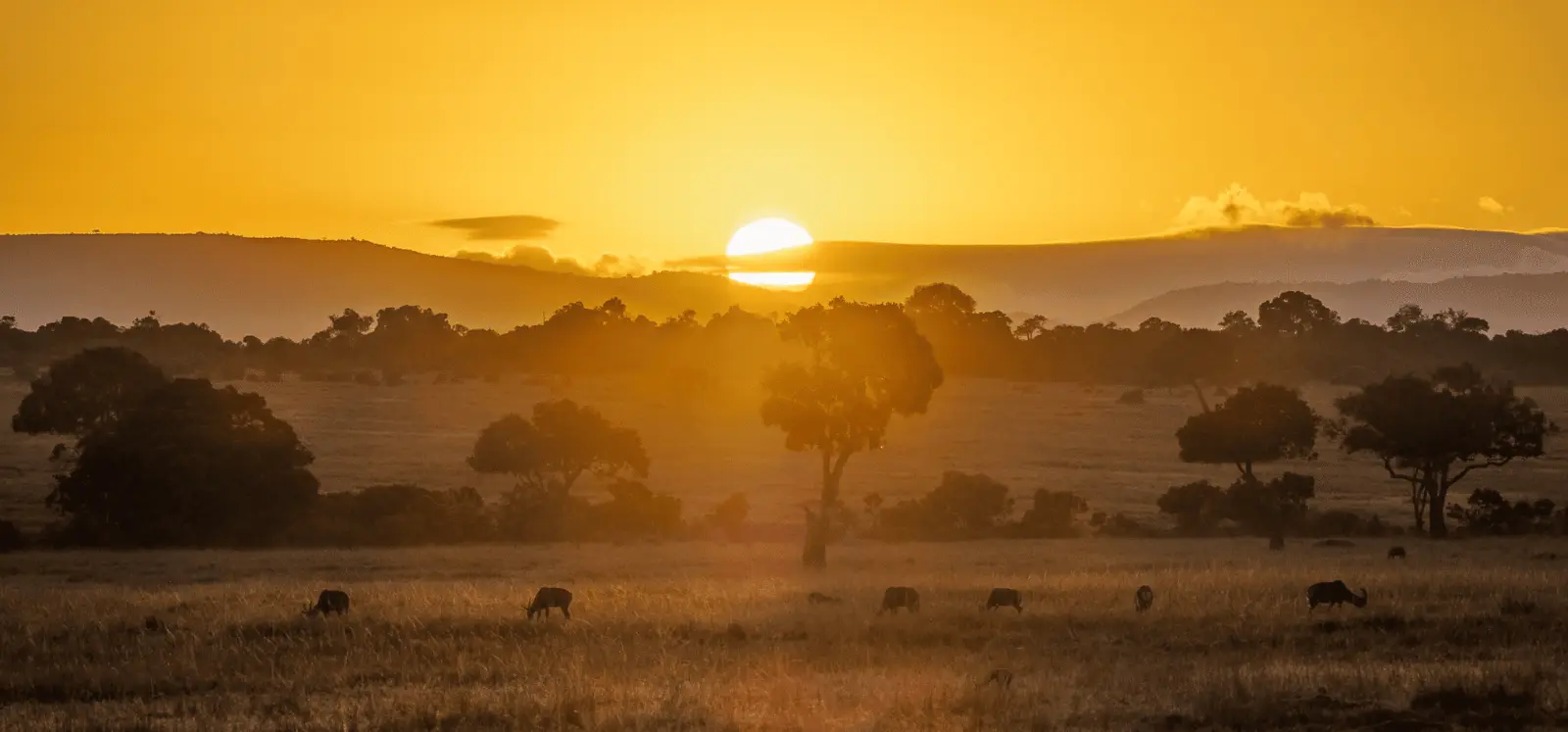
What are the Masai Mara conservancies?
A conservancy in the Mara is a block of land owned by Maasai families and leased, collectively, to tourism operators and conservation groups. Hundreds or thousands of landowners agree to stop farming and heavy grazing on their land, and in return they receive a regular lease payment from the camps that operate there. The arrangement turns wildlife into a source of income for the people who live alongside it, which gives the community a direct reason to protect it.
Masai Mara at a glance
| Size | 1,510 sq km reserve, plus about two dozen community conservancies on its borders |
|---|---|
| From Nairobi | About 270 km: 5 to 6 hours by road or about 1 hour by air |
| Gates | Open 6:00 am to 6:00 pm |
| Reserve fee (non-resident adult) | USD 100 per day Jan to Jun, USD 200 per day Jul to Dec |
| Best for | Big cats, river crossings (Aug to Sep), balloon safaris |
| Peak season | July to October |
Map data OpenStreetMap contributors. Fees are a planning guide and can change.
The conservancies are separate from the national reserve, which is run by Narok County and the Mara Conservancy in the Triangle. They are managed by their own committees and a management company, and they set their own rules, fees and visitor limits. The Mara Conservancies association lists 22 conservancies in the wider Mara ecosystem covering about 176,000 hectares (roughly 1,750 square kilometres) and shared among about 15,000 landowners. Travel sources quote lower numbers, often 14, because they count only the ones next to the reserve. The figures differ depending on what is counted, so treat them as approximate.
Masai Mara conservancies compared with the national reserve
| Conservancies | National reserve | |
|---|---|---|
| Visitor numbers | Capped beds and vehicles | Open to many camps and day visitors |
| Vehicles at a sighting | Usually four or five at most | Rules exist, but crowding is common in peak season |
| Night drives | Allowed in some, until about 10 pm | Not allowed |
| Walking safaris | Offered with Maasai guides | Very limited |
| Off-road driving | Permitted in some, to follow an animal | Not permitted |
| Self-drive | Not permitted | Private cars no longer used for game drives |
| River crossings | Not within conservancies | Mara and Talek river crossings |
| Gate fee | Conservancy fee, usually in the camp rate | County entry fee per day |
The practical point is that the conservancies and reserve complement each other. Wildlife does not recognise the boundaries, so animals move freely between them, and many travellers spend part of their trip in each.
How many tourists are allowed in a conservancy?
Strict density limits are the main selling point. A widely quoted standard is one guest bed per 350 acres, and some conservancies are stricter. Olare Motorogi, for example, is described as having about one bed per 650 acres, with one game vehicle for every 2,100 acres. Naboisho is described as limiting vehicles to four at a sighting. Some camps have as few as a handful of tents. Compare that with the reserve, where large lodges can sleep hundreds of guests.
Because of these limits, you tend to have a sighting to yourself. A lion hunt or a leopard in a tree can be watched for as long as you like, without the pressure of a waiting queue. That is the experience travellers pay a premium for.
The best-known Masai Mara conservancies
Mara North Conservancy
The largest of the group, at roughly 28,000 hectares (about 70,000 acres) on the north-western edge of the reserve. It has golden plains, woodland and riverine forest, and it takes in a section of the migration route. Wildlife includes lion, cheetah, leopard, elephant, hippo, giraffe and spotted hyena. About a dozen tourism partners operate here, including permanent camps and horse-riding outfits. It permits night drives until 10 pm and enforces a 40 km/h speed limit and a maximum of five vehicles near predators.
Mara Naboisho Conservancy
Next to the reserve on its north-eastern side, around 22,500 hectares. It has an intimate, exclusive feel and a high density of lions, with more than 70 individually identified. It is also known for walking safaris with Maasai guides, fly-camping and good cheetah and leopard sightings.
Olare Motorogi Conservancy
A conservancy of around 15,000 hectares north-west of the reserve, known for one of East Africa’s densest lion populations. Residents moved their homesteads out of the area, and only managed cattle grazing is allowed. It acts as a buffer for the reserve and as a corridor for migrating herds. It has a small number of luxury camps.
Ol Kinyei Conservancy
One of the first private conservancies, established in 2005, at about 7,500 hectares. It has rolling hills, riverine forest and open grassland, a resident lion pride, leopards and over 300 bird species. It has been recognised on the IUCN Green List for conservation performance.
Other conservancies worth knowing
- Mara Lemek: A high-density wildlife area with big cats, plains game and a river section.
- Olderkesi: Close to the south-east of the reserve and near the Tanzanian border, owned by Maasai families and managed by trusts.
- Enonkishu: Combines tourism with livestock improvement, and is home to giraffe, buffalo and elephants.
- Nashulai: A Maasai-founded and run conservancy, protecting a migration corridor and an elephant nursery.
- Oloisukut: Home to Maasai giraffe, an elephant corridor and rarer species such as pangolin.
Activities you can do in the Masai Mara conservancies
- Night drives: Spotlights reveal hyenas, genets, servals, bushbabies and, with luck, leopards on the hunt. Night drives are not allowed in the reserve.
- Walking safaris: Led by Maasai or trained guides, they teach you tracks, plants and small creatures you cannot see from a vehicle. See our walking safari guide.
- Off-road game drives: Guides may leave the track to follow a cheetah or a leopard, within strict rules.
- Horse riding: Some conservancies host riding outfits. Our horseback safari guide explains how it works.
- Bush breakfasts and sundowners: Meals set up in the bush by the camp staff.
- Cultural visits: Visits to Maasai homesteads arranged with the community.
What the Masai Mara conservancies cost
Conservancy fees are charged per person per night and are usually included in the camp’s nightly rate, so you rarely pay them separately. They are separate from the national reserve’s entry fee, which you pay per day if you go into the reserve. Since conservancies keep numbers low, the fees are higher than the reserve’s gate rate would suggest, and some of the money goes to landowner leases, rangers and community projects.
When you compare quotes, ask whether conservancy fees are included, and whether any days in the reserve require separate entry. Our Masai Mara entry fees guide sets out the reserve’s current daily rates.
Where does the money go?
The key difference between a conservancy and a private game farm is the community. Lease payments go to landowner families, often thousands of them, every year. Camps employ local guides, rangers and staff. In some conservancies, fees support schools, clinics, bursaries and funds that compensate herders when predators kill livestock. Women’s groups produce beadwork and honey, and some programmes improve livestock breeds so that families can keep fewer, healthier animals.
It is not a perfect system. Reports describe tension in some places between pastoralists and conservancy managers, with cattle moving into restricted areas and landowners saying they are not always involved in decisions or fairly paid. Choose a camp that is open about its community arrangements, and ask how landowners are involved. Our post on responsible safaris and community conservation explains what to look for.
Should you stay in a conservancy or the reserve?
Choose a conservancy if you want quiet sightings, night drives, walks and a more private feel. Choose the reserve if the Mara or Talek river crossings are your priority, since crossings occur in the reserve and not in conservancies, or if you want the widest choice of camps and budgets. Rhinos, which are rare, are most likely to be seen in the Mara Triangle of the reserve.
The best itineraries often combine both: two or three nights in a conservancy for the exclusive experiences, and one or two in the reserve for the river crossings. Our guide to the best Masai Mara lodges and camps shows the options, and the Masai Mara rules guide explains how the rules differ between areas.
Best time to visit the conservancies
The dry months of June to October are the peak for the Great Migration, but the conservancies offer excellent wildlife year-round, because resident lions, cheetahs, elephants and giraffes stay on the plains. The green season from November to May has lower prices, fewer visitors and dramatic skies. See our post on the weather and best time to visit the Masai Mara for a month-by-month view.
How to get to the Masai Mara conservancies
Most conservancies have their own airstrips, such as Olare Orok, Mara North and Ol Seki, and flights from Wilson Airport take about an hour. By road, the journey takes five to six hours from Nairobi, and your camp will collect you from the gate. See our guide to Masai Mara flights and our overview of road and air options.
A sample four-night plan using the Masai Mara conservancies and the reserve
- Nights 1 and 2, conservancy: Fly into a conservancy airstrip and settle in. Do a long afternoon drive, then a night drive on the first evening. On the second day, take a guided walk in the morning and follow a cheetah or leopard off-road in the afternoon.
- Nights 3 and 4, reserve: Move to a camp inside the reserve or the Mara Triangle for the river crossings, which happen only there. Spend full days at the Mara River with a picnic lunch, and try for the rarest sightings, including rhino, in the Triangle.
- Departure: Fly out of the reserve early to avoid a second day’s entry fee.
That mix gives you the exclusivity of the conservancies, the drama of the river and a sensible gate-fee budget. A booking that spends every night in the reserve pays the daily entry fee every day, while one that spends most of the trip in a conservancy pays it only for the days you enter the reserve.
Questions to ask before booking a conservancy camp
- Which conservancy is it, and how big? Bigger areas and tighter bed limits mean quieter drives.
- How many vehicles are allowed at a sighting? Four or five is typical, but ask.
- Are night drives, walks and off-road driving included? Some camps charge extra, and some conservancies restrict one or more of them.
- Is the conservancy fee included in the price? It usually is, but confirm.
- How are landowners involved? A good camp will tell you how many families receive lease payments and what the camp does for local schools and clinics.
- How close is the river? Most river crossings need a half-day trip into the reserve, so ask how long the transfer takes and whether a driver can take you.
Wildlife you can expect in the Masai Mara conservancies
The conservancies hold the same resident wildlife as the reserve: lion, cheetah, leopard, elephant, buffalo, giraffe, zebra, topi, wildebeest, hippo and spotted hyena. The Great Migration moves in and out of the northern conservancies between July and October, so some camps see large herds right at their doorstep. At other times of year, resident herds of zebra, topi and gazelle fill the plains, and predators are easy to find because there are fewer vehicles on the tracks. Birdlife is excellent too, and sunrise drives often include secretary birds, ground hornbills and bateleur eagles.
Frequently asked questions
What are the Masai Mara conservancies?
They are community-owned wildlife areas bordering the Masai Mara National Reserve, leased by Maasai landowners to tourism operators. They cap guest and vehicle numbers and offer activities not allowed in the reserve.
What can I do in a Mara conservancy that I cannot do in the reserve?
Night drives, walking safaris, off-road driving to follow animals and, in some places, horse riding.
Are conservancy fees included in the camp price?
Usually yes. Conservancy fees are normally built into the nightly rate, but always check your quote.
Can I see the river crossings from a conservancy?
The famous Mara and Talek river crossings take place in the national reserve, not in the conservancies, so many travellers spend a night or two in the reserve.
Which is the largest Mara conservancy?
Mara North Conservancy is the largest of the well-known group, at roughly 28,000 hectares (about 70,000 acres).
Can I self-drive in a Mara conservancy?
No. Self-drive is not permitted, and only accredited drivers in authorised vehicles may take game drives.
Not sure whether a conservancy suits you? Ask our team and we will compare options for your dates.