Some honeymoon destinations are beautiful. Kenya is the one couples spend the rest of their lives trying to explain to people who weren’t there. This guide gives you everything you need to plan it right.
The morning your Kenya honeymoon begins to make sense, you probably won’t be expecting it.
It might be your second dawn in the Masai Mara, your guide having slipped the vehicle quietly to the edge of a ridge just as the sun pulls clear of the horizon. Below you, across a mile of open plain still steaming with dew, a cheetah mother and three cubs move through the long golden grass — unhurried, indifferent to you, utterly alive. Your coffee has gone cold. You haven’t noticed.
Or it might come later: a candlelit table set alone in the middle of the bush, two hundred kilometres from the nearest city, the Southern Cross overhead and something large and unconcerned moving through the scrub beyond the lamplight. Your guide has quietly disappeared. It is just the two of you, the darkness, and a kind of silence you’ve never encountered before.
This is what a Kenya honeymoon safari delivers that no beach resort on earth can replicate: not a backdrop for your honeymoon, but an experience that is the honeymoon — one that asks nothing of you except to be present, and rewards that presence with a kind of beauty that reaches the part of you that forgets to be distracted.
Whether you are comparing Africa safari vacation options for the first time or narrowing down the best safari in Africa for your specific situation, this guide covers everything — where to go, when, what it costs, and how to choose between the safari packages and companies competing for your attention. It is built from direct field experience across Kenya’s parks, conservancies, and coast. And it will tell you what most operators won’t.
Key Takeaways
- A Kenya honeymoon safari combines genuine Big Five wildlife encounters with the kind of intimate, private luxury that beach resorts rarely achieve — making it one of the world’s most complete honeymoon experiences.
- Kenya’s four top honeymoon destinations — the Masai Mara, Amboseli National Park, the Laikipia Plateau, and Samburu — each offer a completely distinct landscape and wildlife profile. Multi-park itineraries feel like visiting three countries in a single trip.
- Peak season (July–October) is defined by the Great Wildebeest Migration crossing from Tanzania into the Masai Mara. The green season (November–April) offers exceptional value, lush scenery, and dramatically fewer vehicles on the plains.
- Luxury African safari holidays in Kenya cost approximately $800–$1,500+ per person per night, all-inclusive. Mid-range Kenya safari packages run $300–$600 per person per night.
- Most couples combine their Africa safari with a Kenya coast extension — Diani Beach, Lamu Island, or Watamu — for a seamless wildlife-and-Indian Ocean honeymoon within a single trip.
- Book 6–12 months ahead for peak-season travel. The finest honeymoon camps fill quietly and early, long before their online availability calendars show it.
Why an Africa Safari Honeymoon Outperforms a Beach Vacation
This needs to be said directly, because most honeymoon guides still position an Africa safari as the exotic alternative rather than the obvious first choice.
Beach honeymoons are beautiful. They are also passive. You arrive, you lie down, drinks are brought to you, and the days blur into a warm, sunlit sameness that is — genuinely — restorative. But the couples who have done both, sometimes on the very same trip, consistently describe the Africa safari as the part they remember. Not because the beach disappointed them, but because the safari asked something of them.
Waking before dawn to sit in an open vehicle in the cold dark, watching a pride of lions stir to life at the edge of a waterhole — that is not passive. Neither is tracking a leopard on foot with a ranger, or watching a Mara River crossing unfold in slow motion fifty metres away, knowing you cannot predict the next five seconds. These experiences require a quality of attention that clears everything else from your mind — and that kind of shared attention, unforced and unrepeatable, turns out to be one of the most intimate things two people can give each other.
The best honeymoons generate stories. African safari tours produce more of them, more quickly, than almost any other format on earth.
And here is what most guides skip: you do not have to choose. A Kenya honeymoon safari paired with three or four nights on the Indian Ocean coast gives you both the wilderness and the beach, the Big Five drama and the sundowner coconut. No trade-off required.
Why Kenya Is One of the Best African Safari Destinations for Honeymooners
Africa has extraordinary safari destinations. Tanzania’s Serengeti delivers the wildebeest migration in its rawest, year-round form. Safari South Africa offers some of the continent’s most polished bush lodge infrastructure. Botswana’s Okavango Delta is genuinely unlike anything else on earth.
Kenya combines elements of all of them — within a geography so compact that you can move between the Masai Mara’s vast open grasslands, Amboseli National Park’s elephant-and-Kilimanjaro panoramas, and Laikipia’s exclusive private ranches in a series of forty-five-minute light-aircraft hops. No other East Africa safari destination covers this range within a single trip.
Practicalities also favour Kenya. Direct flights from the UK take approximately 8–9 hours — comparable to Tanzania, meaningfully shorter than South Africa. Nairobi is a well-connected international hub with same-day connections to every major safari region, meaning you can leave London in the morning and watch your first game drive sunset that same evening.
And Kenya’s coast is its own argument. Diani Beach Kenya and Lamu Island are world-class destinations in their own right, each reachable from Nairobi in under an hour. The contrast between the vast, dry openness of a Mara game drive and the warm intimacy of the Indian Ocean is one of the great travel juxtapositions.
How Kenya Compares Against Other Top African Safari Destinations
| Factor | Kenya | Tanzania | South Africa | Botswana |
|---|---|---|---|---|
| Big Five Year-Round | ✅ | ✅ | ✅ | ✅ |
| Wildebeest Migration | ✅ Masai Mara (Jul–Oct) | ✅ Serengeti (year-round) | ❌ | ❌ |
| Beach Extension | ✅ Diani / Lamu / Watamu | ✅ Zanzibar | ✅ Cape Town | Limited |
| Private Conservancies | ✅ Extensive (Laikipia, Mara North) | Limited | ✅ | ✅ Okavango |
| Direct Flights from UK | ~9 hrs | ~9 hrs | ~11 hrs | ~11 hrs |
| Night Drives Available | ✅ Conservancies | ✅ Private areas | ✅ Private areas | ✅ |
| Unique Wildlife | Grevy’s Zebra, Gerenuk, Somali Ostrich | Annual Migration (year-round) | White Rhino | Wild Dog Concentration |
| e-Visa Available | ✅ | ✅ | Visa-free (most) | Visa-free (most) |
| Ngorongoro Equivalent | Great Rift Valley Views | Ngorongoro Crater | Blyde River Canyon | Moremi |
| Green Season Value | ✅ Strong | ✅ | ✅ | Limited |
Four Kenya Safari Destinations That Define a Honeymoon
Kenya is not a single safari experience. Choosing your destination — or combining two or three — means choosing the specific flavour of wilderness your honeymoon is built around. Here is what each of the four major Kenya safari areas actually feels like to be in.
The Masai Mara Safari: Kenya’s Greatest Wildlife Arena
The Masai Mara is the version of Kenya that lives in the imagination before you arrive — open golden plains stretching to a horizon wide enough to make the sky feel larger, the Mara River glinting below a ridge of Croton trees, the air carrying the combined smell of grass and red laterite dust that is, unmistakably, East Africa. In person, it exceeds everything.
What distinguishes the Masai Mara safari from every other wildlife destination is not a single species or landscape feature. It is the density of life. Predators here — lion, leopard, cheetah, hyena, wild dog — exist at concentrations found almost nowhere else on earth. On a strong morning game drive in the Mara, you may encounter three different predator species before breakfast. That is not an exceptional morning here. That is simply a morning.
For honeymooners, the decisive factor is the private conservancies bordering the national reserve: Mara North, Olare Motorogi, Naboisho, Lemek. These areas permit night drives — revealing a nocturnal world of civets, servals, and hunting leopards that daytime visitors never access. Walking safaris are possible. Vehicles can leave tracks and approach wildlife off-road. And because guest numbers are strictly limited, a lion kill sighting is not attended by a queue of fourteen other vehicles.
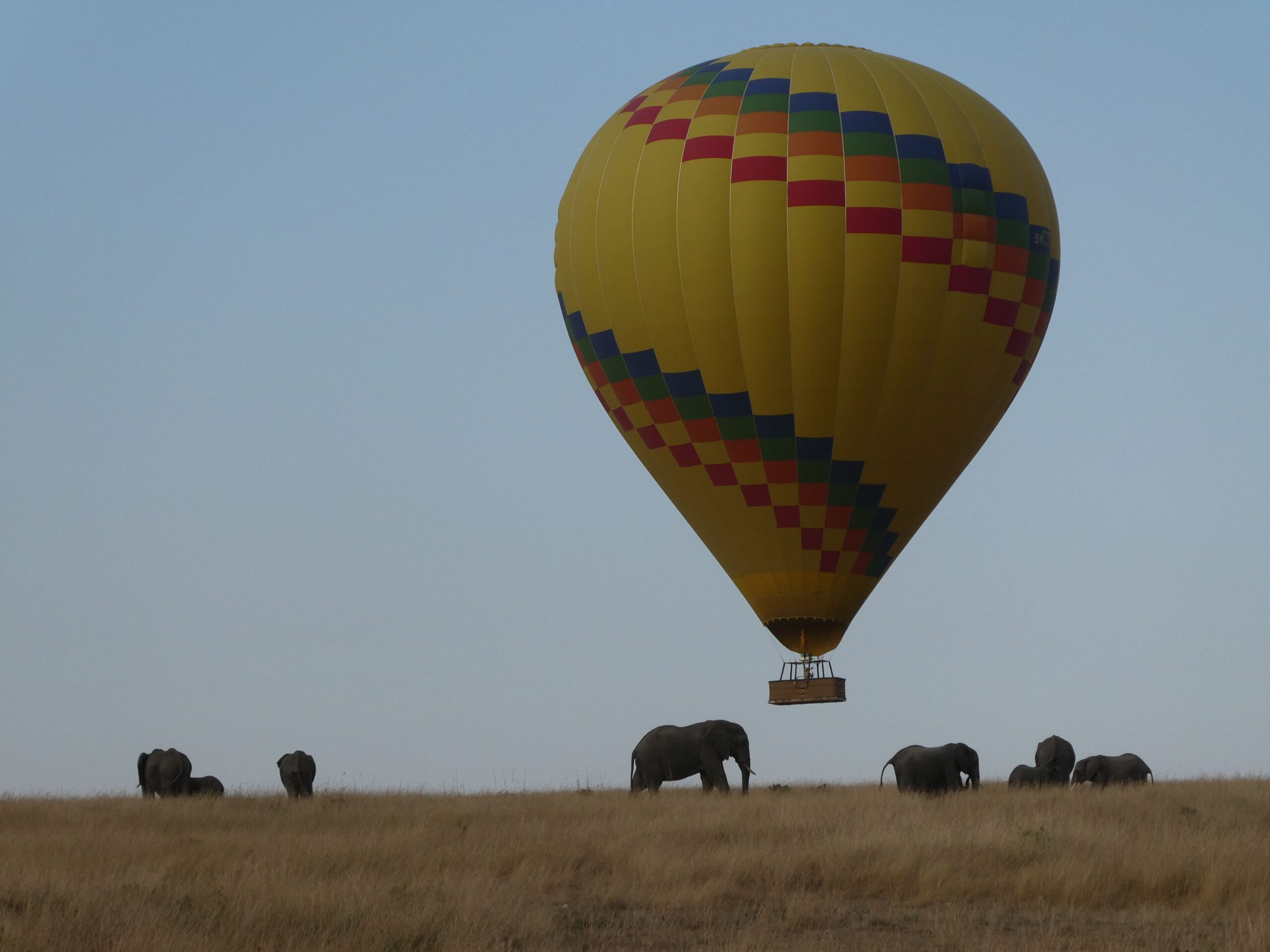
The Masai Mara hot air balloon safari at dawn deserves every word written about it. Drifting at 300 feet above the Great Migration herds, the Mara River turning gold as the sun rises, your partner beside you — it is consistently the single most-named moment of a Kenya honeymoon. It costs approximately $450–$550 per person and lands with a champagne bush breakfast on the open plain. Book it.
The Great Wildebeest Migration — over 1.5 million wildebeest, 200,000 zebra, and 350,000 Thomson’s gazelle crossing from Tanzania’s Serengeti into the Masai Mara — runs from July through October. The Mara River crossings, where herds plunge into crocodile-filled water in a collective act of instinctive momentum, are among the most extraordinary natural spectacles on earth.
One detail most guides miss: the Masai Mara during a full moon is a distinct experience from what daytime visitors see. Several conservancy camps schedule nocturnal drives around the lunar cycle, and the open plains under a full September moon — silver-lit, hippos grazing freely on the riverbank — is something couples describe in detail decades later.
Amboseli National Park Kenya: Elephants, Kilimanjaro, and Pure Romance
If the Masai Mara safari is about scale and predator density, Amboseli National Park Kenya delivers the most cinematically composed safari view in Africa: enormous bull elephants moving through swamp grass, Kilimanjaro’s snow-capped summit — Africa’s highest point — filling the sky behind them. It is photographed obsessively. It still removes conversation when you experience it in person.
The elephants in Kenya’s Amboseli are among the most habituated on the continent — generations raised in a conservation environment where human presence registers as curiosity, not threat. Encounters are extraordinarily close and unhurried. It is common to sit, engine off, while a breeding herd moves around your vehicle at arm’s length, the deep sub-sonic rumble of elephant communication vibrating through the seat beneath you.
The Big 5 animals in Kenya are all present in Amboseli — elephant, lion, buffalo, and leopard roam freely; rhino sightings occur at the ecosystem’s edges. The park is compact and efficient: you spend your time watching wildlife rather than driving through empty terrain. Kilimanjaro views are clearest in the first 90 minutes after dawn and in the golden hour before sunset — cloud typically obscures the peak through midday, which makes the early alarm worth setting.
Best combined with: The Masai Mara. The two parks are different enough in landscape and wildlife character — predator drama versus elephant immersion and mountain scenery — that combining them creates the satisfying feeling of two separate destinations within a single Kenya honeymoon safari.
Laikipia: Kenya’s Most Exclusive Luxury African Safari Experience
The Laikipia Plateau, north of Mount Kenya, is where Kenya’s most exclusive private conservation ranches operate — and where the standard definition of a Kenya safari expands into something altogether different.
Properties here limit their guest numbers to between eight and twenty-four people across entire ranches the size of small counties. There are no public roads nearby, no day visitors, no ambient reminder that the world beyond the conservancy exists. For honeymooners who find even a twenty-tent camp too sociable, Laikipia is the answer — and it represents the finest end of luxury African safari tours available anywhere in East Africa.
The species list justifies the journey. Laikipia holds some of Kenya’s last viable black rhino populations, and several properties offer guided rhino tracking on foot — a completely different quality of encounter from vehicle-based game drives, where you move at the pace of an animal and negotiate terrain on its terms. Grevy’s zebra, reticulated giraffe, and African wild dog complete a profile found nowhere else in Kenya. Activities extend beyond the game drive to guided wilderness walks, horse-riding safaris, and camel treks across open moorland. Couples seeking luxury family safaris or absolute privacy will find Laikipia the most satisfying destination in Kenya’s portfolio.
Samburu: Wildlife Safari in Kenya’s Ancient North
Samburu Game Reserve sits in Kenya’s semi-arid north — five hours from Nairobi by road or one hour by light aircraft. The landscape is ancient and theatrical: bleached-white sand riverbeds lined with doum palms, red laterite escarpments, skies of an intense blue that northern Kenya maintains through most of the year.
Samburu is home to the Special Five — wildlife species found nowhere else in Kenya: Grevy’s zebra, reticulated giraffe, Beisa oryx, gerenuk (a long-necked antelope that feeds standing upright against shrubs), and Somali ostrich. This alone makes a safari in Kenya’s north worth the detour. Exceptional leopard sightings, strong lion prides, and afternoon elephant gatherings along the Ewaso Ng’iro River complete the picture.
The case for Samburu on a honeymoon is partly what it is not: crowded. Vehicle numbers here run at a fraction of the Mara’s. Sightings feel genuinely solitary. The intimacy of the best camps — small, positioned on the riverside — is among the finest in Kenya’s safari circuit.
Lake Nakuru National Park: The Flamingo Detour Worth Knowing
Lake Nakuru National Park, three hours from Nairobi by road, offers one of Kenya’s most distinctive wildlife landscapes — a soda lake periodically hosting hundreds of thousands of lesser flamingos that turn the entire shoreline vivid pink. The park also holds a significant population of both black and white rhino, making it one of Kenya’s most reliable destinations for rhino sightings on the continent.
Lake Nakuru works best as an overnight addition to a longer itinerary — a logical stop between Nairobi and the Mara, or as a standalone night along the Rift Valley lakes route. It is not a primary Kenya honeymoon safari destination, but couples who include it consistently cite the flamingo and rhino combination as one of the most surprising and memorable additions to their Africa safari.
Best Time to Visit Kenya for a Honeymoon Safari
The best time to visit Kenya for a safari honeymoon — and the best time to visit Africa for wildlife — deserves more nuance than most guides provide. Here is the full picture, useful whether your wedding date falls neatly in July or in February.
July to October — Peak Season and the Great Wildebeest Migration
This is the best time to visit Africa for the migration. The Great Wildebeest Migration moves north from Tanzania’s Serengeti into the Masai Mara from July onward — over 1.5 million wildebeest, 200,000 zebra, and 350,000 Thomson’s gazelle. When is the wildebeest migration at its most dramatic? The Mara River crossings — where herds numbering tens of thousands plunge simultaneously into crocodile-filled water — peak between July and September, making this the most spectacular single wildlife period on earth.
Expect: full camps, peak pricing, exceptional predator activity, and a version of the Masai Mara operating at the complete height of its powers. Book 9–12 months in advance.
Full moon nights in this season deserve specific mention. Several conservancy camps schedule nocturnal game drives around the lunar cycle, and the plains under a full September moon — silver-lit, hippos openly grazing, the air thick with insect sound and distant lion calls — is a version of the Mara safari that no daytime visitor experiences.
January to March — Kenya’s Most Underrated Safari Season
This period receives a fraction of the attention it deserves. January through March delivers clear mornings, exceptional Big Five sightings without the vehicle density of migration season, and a version of the Masai Mara that genuinely feels private. Lodge rates run 25–35% below peak. Amboseli enters its calving season — extraordinary elephant family dynamics and a constant stream of newborns. Kenya’s birdlife (1,100+ species) peaks in diversity and visibility.
If your honeymoon dates fall here, do not let anyone convince you otherwise. For many couples, this is the preferred season.
June — The Overlooked Sweet Spot
Migration herds are building north of the Tanzanian border. Predator activity is already exceptional. Rates remain below peak. The best camps still have availability. June is consistently the most underbooked month for honeymooners with any scheduling flexibility — one of the best-kept Kenya travel tips in the industry.
November to December — Green Season and Festive Travel
Short rains fall mainly in the afternoon, clearing to evenings of dramatic skies and extraordinary golden light. The landscape transforms from burnt gold to deep green, producing some of the most photogenic conditions of the year. November rates drop substantially from peak; December’s festive window from approximately the 20th through New Year operates like a second peak season — book early.
April to May — For Experienced Travellers Only
Long rains make some bush roads challenging and cause smaller camps to close temporarily. Crowds thin to their annual minimum. Wildlife concentrates around permanent water. For a first Kenya honeymoon safari, we’d suggest other months; for experienced Africa safari travellers, this offers extraordinary value and genuinely empty parks.
Choosing the Right Kenya Safari Package for Your Honeymoon
Not every camp that uses the word “luxury” delivers what a honeymoon actually needs. The category that matters is not star ratings or bathroom square footage — it is privacy, atmosphere, and the quality of the people looking after you. The finest luxury African safari holidays are defined by these five factors.
Five Things That Differentiate a True Honeymoon Safari Camp
- Your own private outdoor space — a plunge pool, fire deck, star-gazing platform, or star bed (an elevated outdoor sleeping structure under open African sky). Without this, the camp is an expensive hotel room.
- A dedicated guide — not shared with other couples in the same vehicle. Your guide should know your names, remember that you want to find a serval cat, and put the extra blanket in the vehicle before you notice you need it.
- Private bush dinner capability — dinner set away from the main camp, under the stars, just for the two of you. Not standard at every camp. Ask specifically; book specifically.
- Small guest numbers — a camp hosting twelve suites and twenty-four guests at full occupancy is a fundamentally different experience from a lodge with forty rooms and a shared restaurant. Smaller is nearly always better for a honeymoon.
- Quality of naturalist guiding — a guide who holds your attention for ninety minutes at a single lion sighting is worth more to a honeymoon than any room feature. Ask about guide-to-vehicle ratios and exclusive assignment.
What to be cautious of: lodges whose marketing leads with spa facilities and infinity pool photography. A spa is a pleasant addition. A guide who takes you to a leopard with cubs in a sausage tree on your first morning is what you will actually carry home.
Notable Honeymoon Camps by Region
Masai Mara and Private Conservancies
Angama Mara sits on the rim of the Great Rift Valley with floor-to-ceiling views over the entire Mara ecosystem. Mahali Mzuri (Sir Richard Branson’s Mara North property) offers twelve suites with private plunge pools and dedicated butlers. Both represent the $800–$1,200 per person per night tier. For couples prioritising guiding quality: Kicheche Mara and Governors’ Il Moran deliver exceptional field work and small camp sizes at $500–$800 per person per night.
Amboseli National Park Kenya
Finch Hattons is Amboseli’s most romantic property — named after Denys Finch Hatton of Out of Africa, with heated plunge pools in each suite and elephant sightings from your private veranda. Tortilis Camp delivers strong guiding and genuine intimacy at a slightly lower price point.
Laikipia — Luxury African Safari
Ol Jogi limits the entire property to fourteen guests. Helicopter game drives, black rhino tracking on foot, and a private conservancy of extraordinary size make it the most compelling all inclusive African safari experience available in Kenya. It is the finest example of luxury family safaris and couples’ private travel in the country.
Samburu
Sasaab is positioned on the Ewaso Ng’iro River with open-sided suites, private plunge pools, and exceptional leopard sightings — the most honeymoon-specific choice in the north. Elephant Bedroom Camp offers a more intimate atmosphere at a lower price point with strong guiding.
Masai Mara Packages and Sample Kenya Honeymoon Itineraries
These are frameworks, not fixed templates. Every itinerary Cherish Africa Safaris builds is customised around your specific dates, budget, and priorities.
7 Days — The Essential Kenya Honeymoon Safari
Best for: Couples with limited leave wanting Kenya’s greatest experiences without feeling rushed.
Day 1: Arrive Nairobi. Transfer to a boutique property in Karen. Late afternoon visit to the Nairobi Giraffe Centre — feeding Rothschild giraffes by hand is a gentle introduction to East Africa.
Day 2: Nairobi to Masai Mara by light aircraft (Wilson Airport, 45 minutes). Transfer to your conservancy. Afternoon game drive. Sundowners on a ridge. First sounds of the African night.
Days 3–4: Full game drive days in the private conservancy. Night drive on Day 3. Masai Mara hot air balloon safari on Day 4 morning, landing to a champagne breakfast on the open plain. Private bush dinner at sunset.
Day 5: Final Mara morning game drive. Fly to Amboseli National Park Kenya (via Wilson, 90 minutes total). Afternoon game drive — Kilimanjaro is clearest in the golden pre-sunset hour.
Day 6: Full Amboseli day. Dawn elephant encounter session. Afternoon rest at camp.
Day 7: Final morning game drive. Fly back to Nairobi for international connection.
10 Days — Kenya Safari + Indian Ocean Coast
Best for: Couples wanting the complete Africa safari vacation — wilderness and beach in a single honeymoon.
Days 1–2: Arrive Nairobi. Same-day connect to Masai Mara.
Days 3–5: Masai Mara / Mara North Conservancy. Game drives, night drive, private bush dinner, balloon safari.
Day 6: Morning game drive. Fly to Diani Beach Kenya (Wilson Airport to Ukunda, approximately one hour). Check into your coastal property. First Indian Ocean sunset.
Days 7–9: Three nights on the Kenyan coast. Dhow sunset cruise. Snorkelling at Kisite-Mpunguti Marine Park. The quiet luxury of having nowhere to be.
Day 10: Final morning on the beach. Mombasa packages from Nairobi work in reverse: transfer to Mombasa airport for departure. International connection home.
14 Days — The Grand Kenya Honeymoon Safari
Best for: Couples who want the full breadth of Kenya — from Mara grasslands to the ancient north, finishing at the coast.
Days 1–2: Nairobi. Karen boutique hotel. Giraffe Centre and Karen Blixen Museum.
Days 3–4: Amboseli National Park Kenya — elephants in Kenya at their closest, Kilimanjaro, calving herds.
Days 5–7: Masai Mara / Mara North Conservancy — full Big Five experience. Masai Mara hot air balloon. Private bush dinner under the Milky Way.
Days 8–9: Fly to Samburu. The Special Five. Ancient landscape. Leopard and elephant along the Ewaso Ng’iro River.
Days 10–11: Laikipia Plateau — black rhino tracking on foot, walking safari, the most private and exclusive end of the Kenya safari experience.
Days 12–14: Diani Beach or Lamu Island, Kenya. Dhow charters. Snorkelling. The decompression the bush earns.
African Safari Cost: What Kenya Honeymoon Packages Actually Include
Kenya safari packages prices reward honesty — and here it is plainly. Kenya is not cheap. The finest African safari companies charge what they charge because their camps sit within private wilderness concessions, employ highly trained guides, maintain fleets of serviced game-drive vehicles, fly in fresh produce weekly, and keep emergency medical evacuation capacity operational around the clock.
Kenya Safari Package Price Tiers
| Tier | Per Person Per Night | What Is Included |
|---|---|---|
| Budget Safari | $150–$250 | Accommodation, meals, shared vehicle game drives |
| Mid-Range | $300–$600 | All meals, 2 game drives per day, park fees included |
| Luxury African Safari | $800–$1,200 | Fully all-inclusive, private vehicle, park fees, laundry, Wi-Fi |
| Ultra-Luxury | $1,200–$2,000+ | Above + private guide, butler, helicopter options, spa, bespoke experiences |
Realistic Kenya Safari Package Costs Per Couple (Excluding International Flights)
- 7-day mid-range Kenya safari: approximately $6,000–$9,000 per couple
- 10-day luxury Africa safari vacation: approximately $18,000–$25,000 per couple
- 14-day grand Kenya honeymoon including coast nights: approximately $22,000–$30,000 per couple
International flights (UK or US to Nairobi): approximately $1,200–$2,500 per person, depending on carrier and booking lead time.
Budget Separately For
- Masai Mara hot air balloon safari: $450–$550 per person
- Private bush dinner setup: $100–$200 per couple (many camps include this for honeymoon guests on request)
- Tipping in Kenya: $15–$25 per person per day across guide, tracker, and camp staff
- Travel insurance with medical evacuation cover: $100–$200 per person for a specialist Africa safari policy
- Pre-departure health appointments: yellow fever vaccination, malaria prophylaxis consultation
One note on all inclusive African safari pricing: the finest honeymoon camps routinely offer non-advertised inclusions — rose petal arrivals, complimentary champagne setups, upgraded suites — unlocked through a direct relationship with camp management. This is one of the most practical reasons to book through a specialist Kenya safari operator rather than directly through a generic booking platform.
Kenya Beaches: Diani Beach, Lamu Island, and Your Safari Coast Extension
After six to eight days in the bush, you will be ready for the Indian Ocean. Not because the Africa safari has exhausted you — quite the opposite — but because the transition from the vast, open Mara to the warm intimacy of the Kenyan coast creates a completeness that neither half achieves independently.
Diani Beach Kenya — The Classic Safari-to-Coast Combination
Diani Beach sits on Kenya’s south coast, approximately 30km south of Mombasa and a one-hour flight from Nairobi’s Wilson Airport. It offers powdery white sand, warm turquoise water, and a settled atmosphere that suits post-safari decompression ideally. Three to four nights at Diani Beach Kenya after a Masai Mara and Amboseli itinerary is the classic Mombasa packages from Nairobi route — and it earns its popularity.
Lamu Island Kenya — For Couples Who Want the Extraordinary
Lamu Island is for couples seeking something rarer. The island’s principal settlement, Lamu Town, is a UNESCO World Heritage Site — the oldest continuously inhabited Swahili settlement in East Africa, built entirely in coral stone, with no cars (only donkeys and boats), narrow shaded alleyways, and a pace of life so unhurried it operates as its own philosophy. Dhow charters to uninhabited sandbars for private picnics. Nights in a coral-stone courtyard house where the only sounds are the call to prayer and the Indian Ocean.
For honeymooners seeking absolute seclusion, Lamu Island Kenya has very few rivals anywhere in the world.
Watamu — Active Coast for Nature-Focused Couples
Watamu, between Mombasa and Malindi, offers exceptional snorkelling in Watamu Marine National Park, reliable whale shark sightings from October through February, and a selection of eco-conscious lodges suited to couples who want natural beauty without excess. Smaller and quieter than Diani Beach Kenya, it suits couples wanting an active coastal experience with strong conservation credentials.
Kenya and Tanzania Safari Extension
For couples combining a Kenya and Tanzania safari, Zanzibar is the natural coastal chapter — with Stone Town’s ancient atmosphere, the white-sand east coast, and spice tours that extend the cultural dimension of an East Africa trip. Further inland, the Ngorongoro Crater, Serengeti, and Tarangire can be added to create a multi-week East Africa honeymoon.
The Photographs of Your Kenya Safari Honeymoon
Most safari guides skip this entirely. Yet most couples return from a Kenya honeymoon safari with the finest personal photographs they have ever taken — not because they are skilled photographers, but because the subjects, the light, and the setting conspire to make almost anyone look like they are.
East African light — specifically in the hour after dawn and the hour before sunset — has a quality that professional wildlife photographers travel specifically to experience. It is warm, directional, and deeply golden, and it makes everything within it glow. Kilimanjaro at 6:30am reflected in Amboseli’s swamp water. A cheetah on a termite mound against a copper sky. A leopard in a sausage tree in the last afternoon light. These images do not require skill. They require presence.
Practical Photography Guidance for an Africa Safari
- Camera with telephoto zoom of at least 200mm — the 100–400mm range is ideal for African safari wildlife photography; a 500mm prime lens produces the finest single images
- Shoot in RAW format — the golden-hour light rewards editing; your guide will naturally position the vehicle for the light, not just the animal’s position
- For smartphone photographers — modern iPhone and Android cameras handle these conditions better than most expect; a clip-on telephoto lens (Moment, Apexel) extends your reach significantly for wildlife at distance
- Bring lens cloths and a dust cover — red laterite dust is omnipresent in Kenyan safari vehicles and gets into everything
- Memory cards — bring more than you think you will need; most couples take more photographs in their first Masai Mara game drive than in any other single day of the year
The shots most commonly missed: the first dawn light from inside your tent; a candid image of your guide reading animal tracks; your game-drive vehicle disappearing into long grass at distance; the sky at 5am before the drive begins.
Kenya Travel Tips: Health, Visas, and Practical Preparation
Entry and Visa
Most nationalities — including UK, US, EU, Canadian, Australian, and South African passport holders — qualify for a Kenya e-visa applied online before travel. The current cost is $32.50 USD per person; processing takes approximately three business days. Confirm current requirements for your passport at the time of booking.
Kenya consistently ranks among the safest countries in Africa for international travellers, with established safari infrastructure, Kenya Wildlife Service-licensed guides, and emergency evacuation cover standard at all mid-range and luxury camps.
Health Precautions
Yellow Fever: Required if arriving from or transiting through a yellow fever endemic country. Carry your International Certificate of Vaccination regardless — it may be requested at borders or your onward destination. Vaccinate at least 10 days before travel.
Malaria prophylaxis: All Kenyan safari regions are malaria zones. Consult your GP or a specialist travel clinic at least six weeks before departure. Malarone (atovaquone/proguanil) and doxycycline are the most commonly prescribed options.
Travel insurance: Your policy must include emergency medical evacuation — standard travel insurance policies frequently exclude this. AMREF Flying Doctors offers a short-term safari-specific subscription designed for East Africa travellers.
Kenya Safari Packing Essentials
Game drives:
- 3–4 lightweight long-sleeved shirts and trousers in neutral tones (khaki, olive, tan, grey)
- Fleece or light down jacket for pre-dawn drives — July mornings in the Masai Mara regularly reach 10°C
- Comfortable walking shoes or lightweight boots; sandals for camp evenings
- High-SPF sunscreen and SPF lip balm; the combination of altitude and open vehicle exposure is significant
- DEET insect repellent (40%+)
- Quality binoculars — 8×42 is the standard field recommendation
Kenya beaches (Diani / Lamu extension):
- Light summer clothing, swimwear
- A light sarong — appreciated in Lamu’s conservative Swahili culture
- Water shoes for reef snorkelling
Health and documentation:
- Malaria prophylaxis and all prescriptions in original labelled containers
- Rehydration sachets; physical copies of your e-visa, insurance, and yellow fever certificate
Frequently Asked Questions About Kenya Safari Honeymoons
What are the Big 5 in Africa?
The Big 5 in Africa — originally coined by big-game hunters to name the five most dangerous animals to pursue on foot — refers to lion, leopard, elephant, Cape buffalo, and rhinoceros. In modern safari context, a Big Five game drive describes a drive with potential encounters with all five species. All are present in Kenya’s Masai Mara; rhino are most reliably seen in Laikipia’s private conservancies and at Lake Nakuru National Park.
When is the wildebeest migration in Kenya?
The Great Wildebeest Migration enters the Masai Mara from Tanzania from approximately late June through October. The most dramatic Mara River crossings — where herds plunge simultaneously into crocodile-filled water — typically peak from July through September. The migration is not a single event; herds move continuously and crossings can occur multiple times per day at different river points. For the best time to visit Africa for migration, July through September in Kenya is the answer if Mara River crossings are your priority; January through March in Tanzania’s Serengeti is optimal for the calving season.
How much does a Kenya safari vacation cost?
African safari cost varies by tier. Budget Kenya safari packages start at $150–$250 per person per night; mid-range options run $300–$600 per person per night all-inclusive; luxury African safari holidays cost $800–$1,200+ per person per night. A 7-day mid-range Kenya honeymoon safari for two typically costs $6,000–$9,000 excluding international flights; the equivalent luxury safari runs $14,000–$18,000 per couple.
What is tipping in Kenya on safari?
Tipping in Kenya for safari is customary and expected. Standard tipping in Kenya: guide — $15–$20 per person per day; tracker or spotter — $8–$12 per person per day; camp staff (distributed collectively) — $5–$10 per person per day. Tips are best given in Kenyan Shillings (KES) or US Dollars (USD), delivered personally to your guide at the end of your stay. For a hot air balloon pilot and crew, $20–$30 per person is customary.
Who are the best Kenya safari tour operators and how do I choose?
The best Kenya safari tour operators are typically KATO (Kenya Association of Tour Operators) members, hold Tourism Regulatory Authority licensing, and have verifiable reviews on TripAdvisor, Safari Bookings, and Google. When comparing tour companies in Kenya, ask specifically: whether your guide is exclusively assigned, which camps they have direct relationships with (rather than third-party bookings through), whether the itinerary is genuinely customised or a rebranded group tour, and what their response time is when conditions change in the field.
Is Kenya safe for honeymooners?
Kenya is among the safest countries in Africa for international visitors when travel is confined to established safari regions and the coast. The Masai Mara, Amboseli, Samburu, Laikipia, and the Indian Ocean coast all have consistent, uninterrupted track records for international visitor safety. Your specialist Kenya safari operator will provide current, specific advice relevant to your travel dates.
Can I combine a Kenya and Tanzania safari?
A Kenya and Tanzania safari combination is one of East Africa’s most compelling itinerary formats. The Serengeti and Masai Mara share the same continuous ecosystem — the Great Migration moves across both. Adding the Ngorongoro Crater from the Tanzania side brings a landscape found nowhere else on earth. A combined Kenya and Tanzania safari typically requires a minimum of 12–14 days to do both countries justice.
What is the best time to visit Africa for migration?
If the priority is the dramatic Mara River crossings, the best time to visit Africa for migration is July through September in Kenya’s Masai Mara. If the preference is the calving season — thousands of wildebeest calves born within a compressed period — January through March in Tanzania’s Serengeti is the most extraordinary window. Both qualify as among the overall best times for safari in Africa.
Can I add Uganda gorilla trekking to a Kenya honeymoon?
Uganda gorilla trekking is a viable extension for couples building a broader East Africa itinerary. Mountain gorilla trekking in Bwindi Impenetrable Forest is one of the most extraordinary wildlife encounters available anywhere in the world — a face-to-face meeting with wild mountain gorillas in rainforest terrain, on foot. A Kenya and Uganda combination requires 10–14 days minimum. Gorilla trekking permits currently cost $700 USD per person per trek and require advance booking, often six months or more ahead.
What is the minimum time needed for a Kenya honeymoon safari?
A meaningful Kenya honeymoon safari requires a minimum of five to six nights in the field — ideally seven or more. Three nights in the Masai Mara and two in Amboseli represents the practical minimum for the classic combination. Shorter visits are possible but tend to feel rushed; the finest wildlife moments and the most memorable bush experiences typically arrive from the third day onward, once the rhythm of the Africa safari has found you.
Plan Your Kenya Honeymoon Safari with Cherish Africa Safaris
Cherish Africa Safaris is a Nairobi-based East Africa specialist with field experience across the Masai Mara, Amboseli National Park, Laikipia, Samburu, and Kenya’s Indian Ocean coast. As one of the leading safari tour companies in Kenya for bespoke honeymoon design, every Africa safari itinerary we build is tailored to your specific dates, priorities, and budget — with camps selected for the authenticity of their wilderness experience and the genuine quality of their guiding.
We know the Kenya safari companies and camps that deliver on their honeymoon promise — and those that don’t. We know the guides worth requesting by name, the seasonal conditions that will define your game viewing, and the routing that makes the most of every day in the field. We also know when something is not worth the cost — and that honesty is what separates a trip that meets expectations from one that exceeds them.
Ready to start planning your Kenya honeymoon safari? Get your free, fully personalised Africa safari quote — no obligation, just a direct conversation about what is possible for your trip.