Where to see spotted hyenas and African wild dogs in Kenya, how to tell them apart, and what to expect from each sighting.
Quick answer: the spotted hyena is easy to find in the Maasai Mara, Amboseli, Lake Nakuru and Tsavo, and is best watched around dens at dawn and dusk. African wild dogs, also called painted dogs, are far rarer. Kenya’s best chances are on the Laikipia plateau and in the Samburu landscape, and a sighting is a bonus, not a promise. This guide covers how both animals live, where to see hyenas and wild dogs in Kenya, how to tell them apart and how to watch them well.
Hyenas and wild dogs in Kenya at a glance
Spotted hyena
African wild dog
Size
Large, heavy front, sloping back
Medium, lean and long-legged
Coat
Spotted grey-brown
Patchwork of black, tan and white
Ears
Rounded
Big and rounded
Social unit
Clan of up to 80
Pack of 7 to 15, sometimes up to 40
Hunting
At least half of its food, often at night
Cooperative chases in daylight
Conservation status
Least Concern, declining outside protected areas
Endangered, about 6,600 left in Africa
Best Kenya sightings
Mara, Amboseli, Nakuru, Tsavo
Laikipia and the Samburu landscape
Chance of seeing one
High
Low
Spotted hyena in Kenya
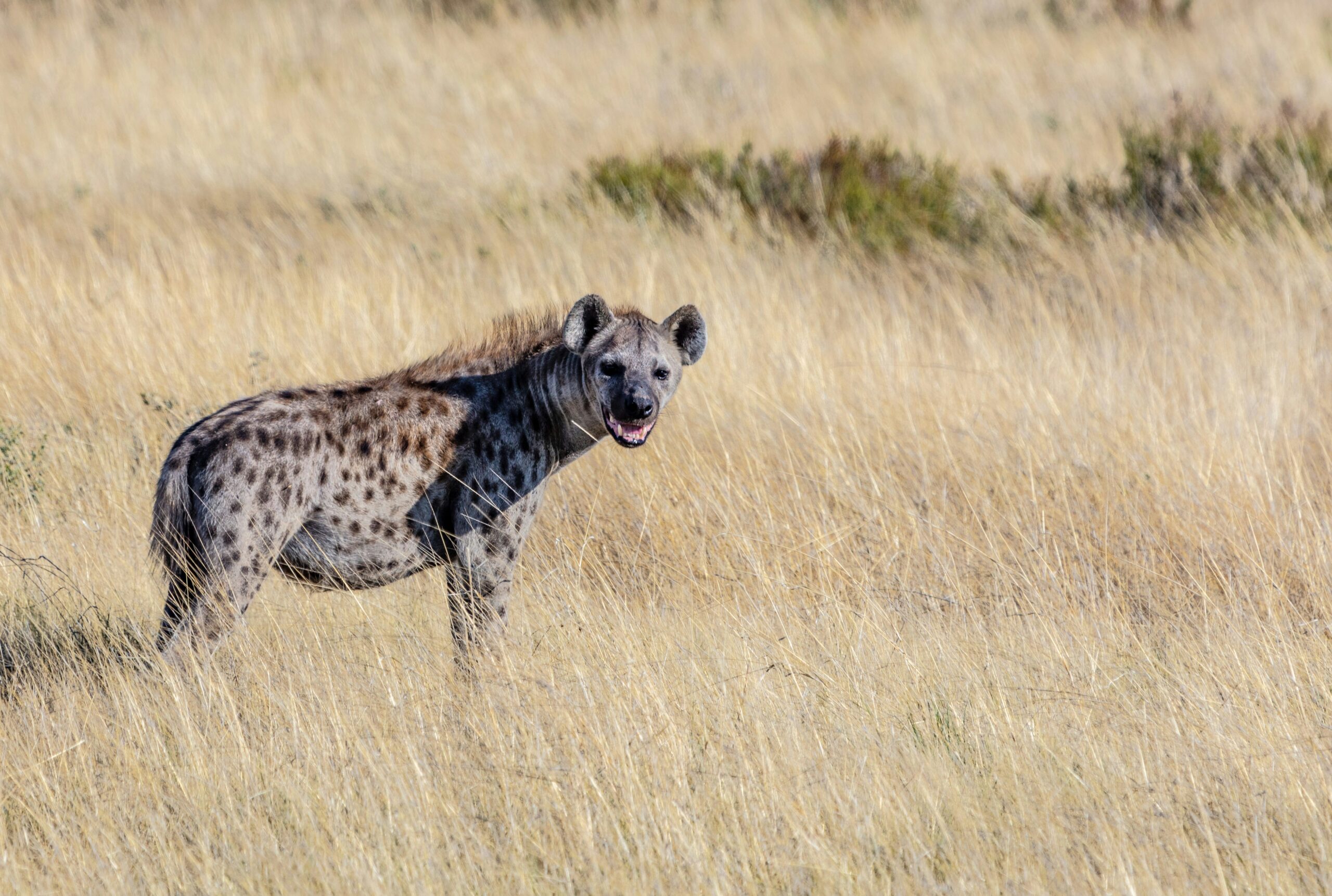
Films cast hyenas as cowardly scavengers, but the real animal is one of Africa’s most successful predators. Spotted hyenas hunt for at least half of their food, and in some populations up to 98%, and they often lose their kills to lions rather than the other way round. They live in clans that can reach 80 animals, and the society is matriarchal: females are larger than males and usually lead. Their bite is among the strongest of any large carnivore, strong enough to crack bones that other animals leave behind.
How a hyena clan works
A clan has a clear pecking order. Cubs inherit the rank of their mother, so a high-ranking female’s cubs get first access to a kill. Cubs are born in dens, usually old burrows enlarged by the clan, and spend months there. Dens are where you get your best photos, because cubs play outside while adults rest nearby. Hyenas communicate with whoops, groans, growls and the well-known giggle, which is an excited or nervous call rather than laughter.
Where to see hyenas in Kenya
The Maasai Mara is the most reliable place, with clans denning close to the tracks, and sightings often come at first light or after a kill. You will also find them in Amboseli, Lake Nakuru and Tsavo. They are mainly active after dark, so the best viewing is at dawn, at dusk and on night drives where they are allowed.
African wild dog in Kenya
About 6,600 wild dogs remain in all of Africa, and they have been endangered for over 20 years. Packs usually number 7 to 15 animals, sometimes up to 40, and they are among the most efficient hunters on the continent. They coordinate their chases, share food with pups and sick pack members and cover huge distances every day, which is exactly why they are so hard to find. Habitat fragmentation is the main threat, along with disease and conflict with livestock owners.
Where to see wild dogs in Kenya
Laikipia and the Samburu landscape are where conservation groups focus their monitoring, and where you have the best chance of a sighting. Community scouts in the Samburu area track pack movements, and the information helps lodges and guides know where the dogs are. Ask your operator which conservancies currently have a pack and whether there is a den, because dens are the best-case scenario: the pack stays put for weeks. Our guides to Laikipia and Samburu explain how those areas work. Be ready to come home without a sighting. If you do see them, you will remember it.
Hyena, wild dog or jackal: how to tell them apart
Spotted hyena
African wild dog
Jackal
Size
Large, heavy front, sloping back
Medium and lean
Small, fox-like
Coat
Spotted grey-brown
Patchwork of black, tan and white
Plain tan or grey
Ears
Rounded
Big and rounded
Pointed
Social
Clans up to 80
Packs of 7 to 15
Pairs or small families
Best Kenya sightings
Mara, Amboseli, Nakuru
Laikipia, Samburu region
Almost everywhere
Myths worth dropping
“Hyenas are cowardly scavengers.” They hunt more than they scavenge and often have food stolen by lions.
“They laugh because they are happy.” The giggle is a nervous or excited call.
“Wild dogs are just stray dogs.” They are a separate species with a unique painted coat and a complex social life.
“Hyenas are related to dogs.” They are actually closer to mongooses and cats than to dogs.
How to watch hyenas and wild dogs well
Ask your guide to check known den sites in the morning.
Stay quiet and keep a gap. Pups wander, and the adults are watching you.
Use a longer lens for wild dogs, which move quickly when the pack starts running.
Do not crowd a hunt. Your presence can tip a kill, and spotted hyenas lose many kills to lions already.
Be patient. A resting pack can suddenly burst into a chase, and a hyena den can take an hour to show you everything.
Hyenas are visible all year. For wild dogs, the dry months from June to October make tracking easier and the animals more visible on open ground. Denning season, when wild dog pups are small and the pack stays put, offers the best odds, so ask your operator about current den activity before you book. See the best time to visit Kenya for how seasons shape each park.
Where hyenas and wild dogs fit in the wider cast
They sit just below lions and leopards in the predator ranking, and they share the plains with cheetahs. Seeing the full set of predators in one trip takes planning, and our Kenya wildlife field guide explains where each one is most likely to show.
Why hyenas in Kenya deserve more attention
Hyenas in Kenya are often the animals that safari visitors misunderstand most. Films cast them as cowardly scavengers, yet the spotted hyena is one of Africa’s most successful predators. It hunts much of its own food, lives in complex clans and has a social structure ruled by females. Studies suggest that in many ecosystems, hyenas kill more prey than they steal. Spend a dawn or dusk watching a clan near its den, and you quickly see why guides call them the most intelligent and underrated carnivore on the plains.
Hyena behaviour you can watch on a Kenya safari
Dens: clans raise cubs at communal dens, often with burrows dug into banks. Cubs are born dark and spend weeks underground before venturing out.
Greeting ceremonies: hyenas lift a leg and sniff each other, a social bonding ritual that reinforces rank.
Vocalisations: the famous whoop calls carry for kilometres and help clan members find each other. The so-called ‘laugh’ usually signals stress or excitement.
Hunting: hyenas hunt together at night or in the early morning, chasing wildebeest, zebra and gazelles over long distances.
Feeding: they crush bones with powerful jaws and digest almost the entire carcass, including bone, which makes their droppings white.
Clans, females and rank
A hyena clan can have a few animals or more than eighty. Females are larger than males and dominate them, and rank is inherited from the mother, so a cub born to a high-ranking female enjoys a privileged life. Males often leave the clan at maturity and join another, where they must start at the bottom. Females also have an unusual anatomy that allows them to give birth through an elongated structure, which makes birth difficult and dangerous. This unusual biology, along with their social complexity, has made hyenas a subject of decades of research, including in the Masai Mara.
Best places to see hyenas in Kenya
The Masai Mara is excellent for hyenas, especially around the lion kills of the migration season. Amboseli, Lake Nakuru and Nairobi National Park also have good populations, and hyenas are common in Tsavo and Samburu. Look for them near kills, at den sites in the evening and along roads at dawn. Striped and brown hyenas are rarely seen, and the spotted species is the one visitors meet. See our lion guide, leopard guide and Masai Mara guide for places where hyenas share territory with the big cats.
Wild dogs: Kenya’s rarest predator
African wild dogs are among the most endangered carnivores in Africa. In Kenya they live mainly in Laikipia and the northern rangelands, and sightings elsewhere are occasional and exciting. They hunt in packs, chasing prey over long distances, and have one of the highest hunt success rates of any predator. Pack members share food and care for sick or injured companions. Because they range widely and are vulnerable to disease and snares, conservation depends on private landowners and communities. See the Laikipia guide for places to look.
Safety and respect around hyenas
Hyenas are wild animals and should be treated with care. Never feed them or leave food where they can reach it. In camps without fences, stay inside your tent at night and follow staff instructions. During drives, keep a safe distance, stay in the vehicle and do not shine lights directly at animals. Hyenas are curious and may approach a vehicle, but they are not usually aggressive. Learn about them and you will leave with a better understanding of how the African savannah works. For a tailored itinerary, contact us.
Frequently asked questions
Where can I see African wild dogs in Kenya?
Mostly on the Laikipia plateau and the wider Samburu landscape. They are rare and wide-ranging, so sightings are never guaranteed.
Where is the best place to see spotted hyenas in Kenya?
The Maasai Mara is the most reliable, followed by Amboseli, Lake Nakuru and Tsavo. Dawn and dusk near dens give the best viewing.
Are hyenas dangerous on safari?
Not to guests in a vehicle or tent camp. Spotted hyenas can be bold around camps at night, so follow your camp rules and never leave food out.
Do hyenas really laugh?
The giggle is a nervous or excited call, not humour. Hyenas use whoops, groans and giggles to communicate.
Do hyenas hunt or scavenge?
Both. Spotted hyenas hunt for at least half of their food and often lose kills to lions.
How many African wild dogs are left?
About 6,600 in all of Africa, and the species has been endangered for over 20 years.
What is the difference between a hyena and a wild dog?
Hyenas are larger, heavy-shouldered and spotted. Wild dogs are lean, long-legged and have a patchwork coat of black, tan and white.
How big is a hyena clan?
Spotted hyena clans can reach 80 animals, though they are often smaller where prey migrates.
Francis writes and curates the safari guides, destination features and travel tips on this site. Working with the Cherish Africa Safaris team in Kenya, he turns first-hand knowledge of the parks, wildlife seasons and routes into clear, practical advice, so you can plan your safari with confidence.
Have a question about a destination or an itinerary? Write to him directly.
To provide the best experiences, we use technologies like cookies to store and/or access device information. Consenting to these technologies will allow us to process data such as browsing behavior or unique IDs on this site. Not consenting or withdrawing consent, may adversely affect certain features and functions.
Functional Always active
The technical storage or access is strictly necessary for the legitimate purpose of enabling the use of a specific service explicitly requested by the subscriber or user, or for the sole purpose of carrying out the transmission of a communication over an electronic communications network.
Preferences
The technical storage or access is necessary for the legitimate purpose of storing preferences that are not requested by the subscriber or user.
Statistics
The technical storage or access that is used exclusively for statistical purposes.The technical storage or access that is used exclusively for anonymous statistical purposes. Without a subpoena, voluntary compliance on the part of your Internet Service Provider, or additional records from a third party, information stored or retrieved for this purpose alone cannot usually be used to identify you.
Marketing
The technical storage or access is required to create user profiles to send advertising, or to track the user on a website or across several websites for similar marketing purposes.