Ol Pejeta Conservancy: Kenya’s Only Place to See the Last Northern White Rhinos
Most “which Kenya park should I visit” content sticks to the same three names — Mara, Amboseli, Tsavo — and skips a destination that offers something genuinely unrepeatable anywhere else on the planet. Ol Pejeta Conservancy, in Laikipia County between the Aberdares and Mount Kenya, isn’t just another Big Five park. It’s the only place on Earth where you can see a northern white rhino, and one of the only places in Kenya where you can see a chimpanzee at all.

What Makes Ol Pejeta Different From Kenya’s Other Safari Destinations?
Ol Pejeta Conservancy started life as a colonial-era cattle ranch, expanded from 230 to 360 square kilometers under management beginning in 1949, and was acquired in 2004 by the UK-based conservation group Fauna & Flora International with $15 million in backing from the Arcus Foundation — a transformation from ranch to full conservation model that’s now one of the most complete in East Africa (Wikipedia — Ol Pejeta Conservancy). Unlike a standard national park, Ol Pejeta combines Big Five wildlife viewing, East Africa’s largest black rhino sanctuary, a chimpanzee sanctuary found nowhere else in Kenya, and direct community development work — all inside one privately managed conservancy roughly four hours from Nairobi.
Why Is Ol Pejeta the Only Place on Earth to See a Northern White Rhino?
Because there are only two northern white rhinos left alive anywhere, and both live at Ol Pejeta. Four northern white rhinos — two males, Sudan and Suni, and two females, Najin and Fatu — arrived at the conservancy on December 20, 2009, transferred from the Dvůr Králové Zoo in the Czech Republic as part of a last-ditch effort to breed the subspecies before it disappeared entirely (Wikipedia — Ol Pejeta Conservancy). Suni died in 2014. Sudan, the world’s last male northern white rhino, was euthanized in 2018 due to age-related health complications — his death made headlines globally as the effective end of natural reproduction for the subspecies. Today, only Najin and Fatu remain, both female, making natural breeding biologically impossible (Ol Pejeta Conservancy).
The northern white rhino is now considered functionally extinct in the wild, kept from complete extinction only through advanced reproductive science — stored genetic material and embryo research aimed at one day reintroducing the subspecies via surrogate southern white rhinos. Visiting Najin and Fatu at Ol Pejeta isn’t a standard wildlife sighting; it’s a chance to see a subspecies at the exact edge of extinction, in the one place on the planet where that’s currently possible.
Can You See the Big Five at Ol Pejeta?
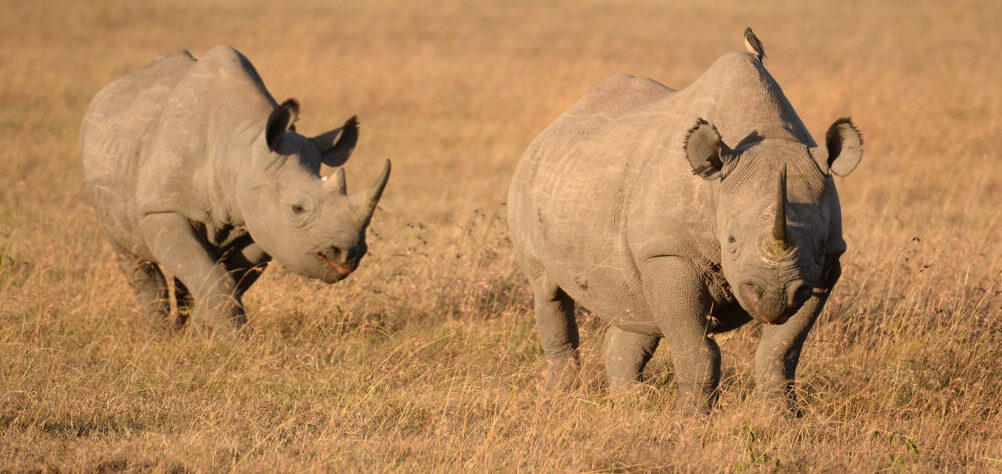
Yes — lion, African leopard, African bush elephant, Cape buffalo, and rhinoceros are all present at Ol Pejeta, making it one of the relatively few Kenyan destinations where a genuine Big Five sighting is realistic in a single conservancy (Wikipedia — Ol Pejeta Conservancy). The rhino component alone is exceptional: Ol Pejeta is home to the largest black rhino sanctuary in East and Central Africa, having grown its population from just 20 individuals in 1993 to more than 165 today through sustained breeding and anti-poaching programs, alongside 44 southern white rhinos introduced starting in 2005 (Ol Pejeta Conservancy). For travelers who specifically want strong rhino odds — something the Maasai Mara and Amboseli can’t reliably promise, as our Maasai Mara vs Amboseli vs Tsavo post covers in more detail — Ol Pejeta is arguably Kenya’s single best rhino destination.
Where Can You See Chimpanzees in Kenya?
Only at Ol Pejeta. Chimpanzees aren’t native to Kenya, but the Sweetwaters Chimpanzee Sanctuary within the conservancy — established in 1993 through a partnership between Ol Pejeta, the Kenya Wildlife Service, and the Jane Goodall Institute — is described on Wikipedia as “the only place in Kenya where chimpanzees can be seen.” The sanctuary is a genuine rescue and rehabilitation facility, currently housing 43 chimpanzees across two large groups separated by the Ewaso Nyiro River, most rescued from illegal wildlife trafficking or unsuitable captivity elsewhere in Africa (Wikipedia — Ol Pejeta Conservancy). If seeing a chimpanzee is on your Kenya bucket list, this is genuinely the only stop that makes it possible.
How Far Is Ol Pejeta From Nairobi, and How Do You Get There?
Closer than most first-time visitors expect: Ol Pejeta’s own visitor information puts it at 220 kilometers, roughly a 4-hour drive from Nairobi via Nanyuki on well-maintained roads (Ol Pejeta Conservancy). Scheduled flights also serve Nanyuki Airstrip, with a short transfer completing the trip to the conservancy itself, for travelers who’d rather not spend half a day on the road.
Is Ol Pejeta Worth Adding to a Kenya Safari Itinerary?
For most travelers building a longer trip, yes — it pairs naturally with the Nairobi-to-Laikipia-and-Samburu region rather than the Mara-Amboseli circuit most first-time itineraries default to. our 7 Day Kenya Safari Itinerary post covers the standard Mara-and-Amboseli week, but travelers with 9-10 days, or a specific interest in rhino conservation, primate encounters, or something genuinely different from the classic Big Five checklist, should seriously consider swapping in a Laikipia leg built around Ol Pejeta. It’s also a strong fit for travelers combining a safari with a Mount Kenya climb or stay, given the conservancy’s location right between the mountain and the Aberdares.
So, Should You Add Ol Pejeta to Your Trip?
If a standard Big Five safari feels like it’s missing something distinctive, Ol Pejeta is one of the clearest ways to add genuine substance to a Kenya itinerary — not just more wildlife, but wildlife you can’t see together, or at all, anywhere else on the continent. The chance to see Najin and Fatu specifically is finite in a way few safari experiences are; the northern white rhino’s story won’t have the same ending for much longer.
Tell us how many days you have and whether conservation, primates, or rhino conservation specifically interests you, and we’ll tell you honestly whether a Laikipia leg through Ol Pejeta fits your trip.
Frequently Asked Questions
Where can I see the last northern white rhinos in the world?
Only at Ol Pejeta Conservancy in Laikipia County, Kenya. Najin and Fatu, both female, are the only two northern white rhinos left alive anywhere on Earth, following the death of the last male, Sudan, in 2018.
Can you see chimpanzees on a Kenya safari?
Only at Ol Pejeta’s Sweetwaters Chimpanzee Sanctuary — described as the only place in Kenya where chimpanzees can be seen. The sanctuary currently houses 43 rescued chimpanzees.
How far is Ol Pejeta Conservancy from Nairobi?
About 220 kilometers, roughly a 4-hour drive via Nanyuki. Scheduled flights to Nanyuki Airstrip are also available for a faster transfer.
Can you see the Big Five at Ol Pejeta?
Yes — lion, leopard, elephant, buffalo, and rhino are all present. Ol Pejeta is also home to East and Central Africa’s largest black rhino sanctuary, with more than 165 individuals.
Is Ol Pejeta better for rhinos than the Maasai Mara?
For rhino sightings specifically, yes — Ol Pejeta’s dedicated sanctuary and larger, actively managed population give it stronger and more reliable rhino odds than most other Kenyan parks and reserves.
Written by Francis, Cherish Africa Safaris. Interested in adding Ol Pejeta to your itinerary? Get in touch and we’ll tell you honestly how it fits with the rest of your trip.