Best Time to Visit Kenya for a Safari: A Month-by-Month Guide
This is the question we get more than any other, and it’s usually followed by a second one: “but what about the migration?” The honest answer is that Kenya rewards planning around two separate things — the general dry-season rhythm that makes game viewing easier everywhere, and the Masai Mara’s migration window specifically, which is narrower and doesn’t line up with the rest of the country’s calendar. And Kenya is bigger and more varied than the Mara alone, so the right month also depends on which parks are actually on your itinerary.
When Is the Best Time to Visit Kenya, Really?
Late June through October is the safest all-round choice. This is Kenya’s long dry season, water sources shrink, animals concentrate around what’s left, and it also happens to overlap with the Masai Mara’s river-crossing months. January and February form a shorter second dry window that’s quieter and greener, and genuinely underrated if your dates are flexible.
The two rainy seasons to plan around rather than ignore are the long rains (roughly March–May) and the short rains (late October–December), which is when trails get muddy, some camps close for maintenance, and game viewing gets a little harder simply because animals don’t need to cluster around fixed water points.
What’s the Weather Actually Like, Region by Region?
Kenya isn’t one climate — the Mara highlands, Nairobi, and the coast behave quite differently, and independent climate data bears that out clearly (WeatherSpark):
| Region | Driest month | Wettest month | Warmest | Coolest |
|---|---|---|---|---|
| Nairobi / Highlands | July (~3mm rain) | April (~84mm) | Feb, highs around 27°C | July, highs around 22°C |
| Masai Mara (Narok) | July (~13mm) | April (~155mm) | Jan–Feb, highs around 26°C | July, highs around 21°C, drops to ~10°C at night |
| Coast (Mombasa) | August (~15mm) | May (~137mm) | March, highs around 32°C | July, highs around 27°C |
Two things worth noticing in that table. First, July is the driest month almost everywhere in Kenya — it’s also the coolest, especially in the Mara, where night game drives genuinely need a jacket. Second, April is the wettest month across the highlands and the Mara alike, which is exactly why so many camps schedule their annual maintenance closures then.
When Does the Migration Actually Reach the Masai Mara?
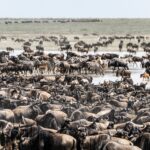
The wildebeest typically arrive in the Masai Mara from Tanzania’s Serengeti around July, spend the next few months moving back and forth across the Mara River, and begin heading back south again around late October into November. That’s the same herd we cover from the Serengeti side it’s one migration, and which side of the border it’s on at any given moment depends on rainfall, not a fixed date.
If you’re specifically chasing river crossings, July through September is the tightest window. If you’d rather have the Mara to yourself with lower rates and don’t mind missing the crossings, February is worth serious consideration — the resident wildlife doesn’t leave, migration or not, and it lines up with the Mara’s warmest, driest daytime weather of the year.
Is Amboseli Worth Visiting If You Care About Timing?
Amboseli rewards good timing more than most Kenyan parks, but not for the reason people expect. The ecosystem supports around 1,500 elephants year-round, sustained by swamps fed from Kilimanjaro’s own mountain catchment rather than local rainfall, so the elephants themselves are there whatever month you visit (Amboseli Trust for Elephants, a research organization that’s studied this population for decades). What timing actually affects is Kilimanjaro itself — the mountain is far more likely to be cloud-free early in the morning, and clearer overall during the dry months, so a dawn game drive in July–October or January–February gives you noticeably better odds of that classic elephants-against-Kilimanjaro shot than an afternoon drive in the rains.
What Makes Samburu Different From the Rest of Kenya?
Samburu National Reserve sits in Kenya’s drier north, and it’s built around a permanent water source — the Ewaso Ng’iro River — which makes it one of the more reliable year-round destinations regardless of season. It’s also the best place in Kenya to see the “Samburu Special Five”: Grevy’s zebra, reticulated giraffe, gerenuk, Somali ostrich, and beisa oryx, none of which you’ll reliably find in the Mara or Amboseli (Africa Geographic). If your itinerary already covers the Mara, adding two or three days in Samburu gives you a genuinely different species list rather than more of the same wildlife in a different location.
What About the Rift Valley Lakes?
Lake Nakuru’s flamingos and rhinos, along with nearby Lake Naivasha, are resident populations rather than seasonal visitors, similar to how Ngorongoro Crater works in Tanzania. Timing matters here mostly for comfort and photography light rather than for whether the wildlife shows up at all — the dry months make for easier roads and clearer views across the lake.
Trying to work out which combination of parks actually fits your timeline — Mara, Amboseli, Samburu, or all three? Tell us your dates and priorities and we’ll build the itinerary around what’s realistic, not just what sounds good on paper.
When Should You Add the Coast?
If you’re combining your safari with Diani or Mombasa, independent climate data puts December through March and July through September as Kenya’s driest coastal windows, with May bringing the heaviest rain of the year (around 137mm) and April not far behind. November’s short rains are lighter and shorter-lived, and plenty of travelers still enjoy the coast then — just expect the odd afternoon shower. March is also the warmest month on the coast, with highs around 32°C, so pack for genuine heat and humidity rather than the cooler highland temperatures you’ll have just left behind in the Mara.
What Do You Need to Know About Kenya’s eTA Before You Book?
Most visitors need Kenya’s Electronic Travel Authorization, applied for in advance through the official government portal. Standard processing starts at $30 and can take up to 72 hours; if you’re booking last-minute, expedited processing is available for an additional $100 on top. Apply as early as your dates allow — the standard tier is significantly cheaper, and there’s no good reason to pay for expedited unless your travel dates genuinely require it.
So When Should You Actually Go?
Chasing the Mara river crossings: July through September, and book your camp early since this is peak season across the board. Want the Mara’s resident wildlife, plus Amboseli’s clearest Kilimanjaro views, without the crowds or peak-season rates: January or February. Adding Samburu’s dry-country species to a classic itinerary: genuinely works any month, given its permanent river. Combining with the coast: aim for the overlap of December–March or July–September, when both the bush and the beach are dry. On a tighter budget and comfortable with some rain: April, May, and November are quieter for a reason, and it’s mostly weather, not wildlife.
If you tell us your dates and priorities, we’ll tell you honestly whether they line up.
Frequently Asked Questions
Do I need to time my trip around the migration to have a good Kenya safari?
No — the Mara’s resident wildlife is there year-round, and parks like Amboseli, Samburu, and Lake Nakuru aren’t migration-dependent at all. The migration is a bonus, not a requirement.
What’s the cheapest month to go on safari in Kenya?
April and May typically bring the lowest camp and lodge rates, thanks to the long rains keeping visitor numbers down — though it’s also the wettest stretch across the highlands, Mara, and coast alike.
When’s the best time to photograph elephants with Kilimanjaro in the background at Amboseli?
Early morning during the dry months (July–October or January–February) gives you the best odds of a cloud-free mountain — afternoons and the rainy season make the summit far less reliable to see.
Is Samburu worth adding to a Masai Mara safari?
Yes, if you want a genuinely different species list rather than more of the same — the Samburu Special Five (Grevy’s zebra, reticulated giraffe, gerenuk, Somali ostrich, and beisa oryx) don’t reliably appear in the Mara.
Can I combine a Kenya safari with Tanzania on one trip?
Yes, and it’s a natural pairing given how close the Mara and Serengeti sit to each other — just note that Tanzania needs its own separate visa, since it isn’t covered by Kenya’s eTA.
Written by Francis Magere. Have questions about timing your own Kenya safari? Get in touch for a personalized itinerary, or reach us directly on WhatsApp.