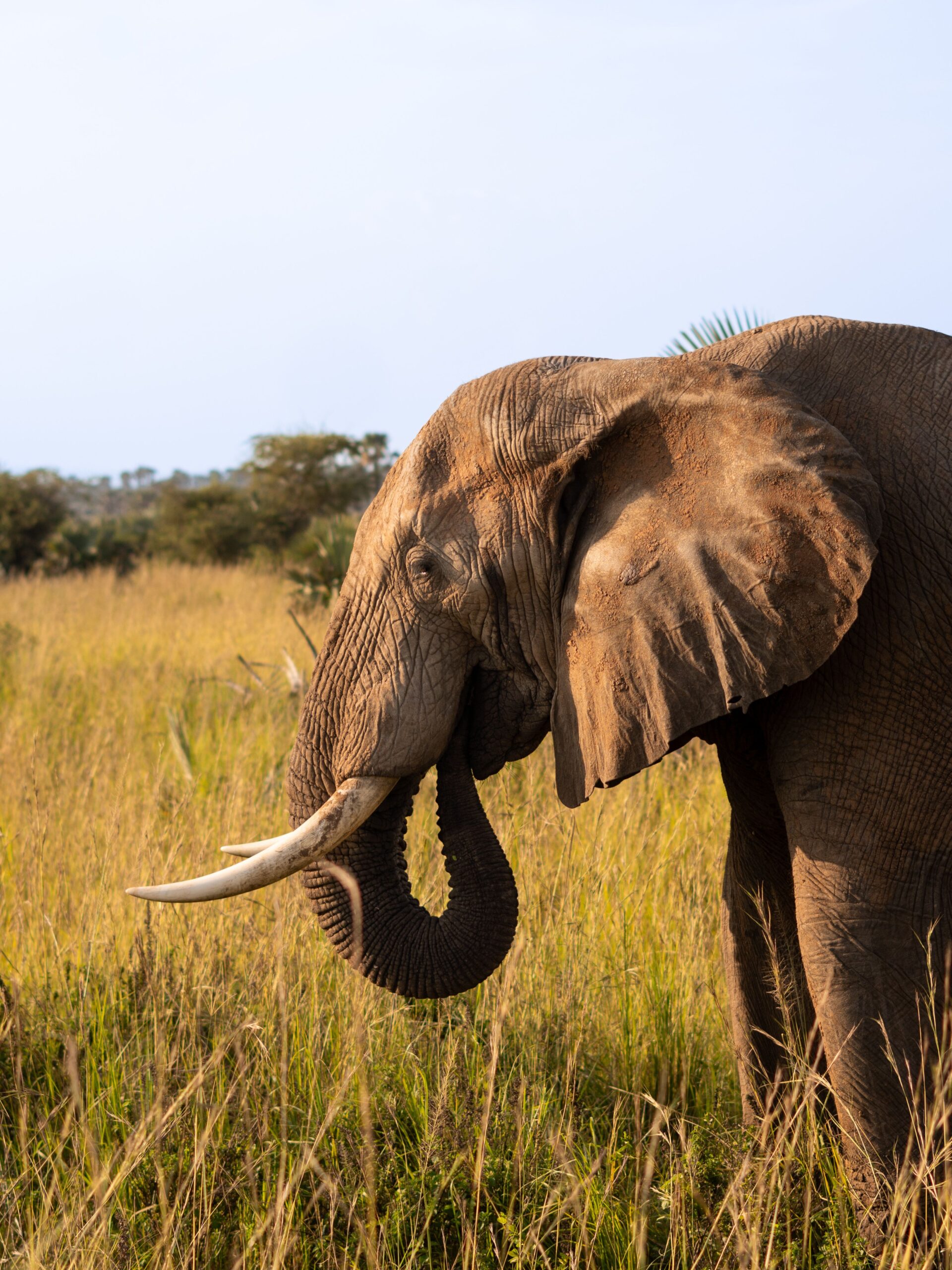
The first time you see the Tsavo red elephants, you assume the camera is lying. A herd walks out of the bush the colour of a brick, and the baby beside its mother looks as if it has been dipped in terracotta paint. They are real, they are ordinary African elephants, and seeing them is one of the best reasons to put Tsavo East on a Kenya safari. This guide explains why the elephants are red, where and when to find them, how many live in Tsavo, and what else makes the park worth the drive.
Tsavo red elephants: why are they red?
The colour of the Tsavo red elephants is not genetic. It is soil. Tsavo’s earth is rich in iron oxide, the same compound that makes rust red. Elephants take dust baths and mud baths to cool down, to protect their skin from the sun and to keep biting insects away. They suck dust into their trunks and blow it over their backs, so a thin coat of red soil clings to the skin. A swim in a river or a heavy rain can wash much of it off, and the elephants then look grey until the next dust bath.
Compare them with elephants in other parks. In the Maasai Mara, where the soil is dark “black cotton” clay, they look grey or charcoal. In Namibia’s Etosha, where they dust in white salt pans, they look pale. Each herd takes on the colour of its home ground.
Where to see Tsavo red elephants in Tsavo East
Tsavo East covers 13,747 km² and was gazetted as a national park in April 1948. Together with neighbouring Tsavo West it makes a protected area of about 22,000 km², one of the biggest in the world. The best places to find the red herds are:
- The Galana River: The park’s only permanent river. Herds come down to drink and bathe, especially in the dry season. Look for them near Lugard Falls, a stretch of rapids and polished rock on the river.
- Aruba Dam: A man-made reservoir built across the Voi River in 1952. In the dry months it draws elephants, buffalo and waterbirds in large numbers.
- Mudanda Rock: A 1.6 km-long rock outcrop that catches rainwater and feeds a natural dam below. From the top you can watch herds drinking, particularly in the late afternoon.
- The red-soil plains: Even away from water, the open plains around Voi and the main game-drive circuits are where herds feed and dust-bathe.
Read our Tsavo East guide for the best circuits, gates and distances, or the Tsavo East and West comparison if you want to compare the two halves.
How many elephants live in Tsavo?
Tsavo holds the largest elephant population in Kenya. Aerial counts show steady growth:
| Year | Elephants counted in the Tsavo ecosystem |
|---|---|
| 2014 | 11,217 |
| 2017 | 12,866 |
| 2021 | 14,964 |
That 2021 figure was about 41% of Kenya’s 36,280 elephants at the time. Kenya’s 2025 national census counted 41,952 elephants in the wild, so the country’s total has also kept climbing. The growth is credited to stronger anti-poaching work and stable security, though it also brings pressure on the land.
Tusker legends and the poaching threat
Tsavo is famous for its “tuskers”, old bulls whose tusks reach the ground. Satao, one of the best known, was killed by poachers with a poisoned arrow in May 2014, and a successor, Satao II, was killed in 2017. Anti-poaching units, including teams supported by the Tsavo Trust and the Sheldrick Wildlife Trust, now use aircraft, ground patrols and rapid-response vets to protect the remaining giants. Sheldrick also runs elephant orphan rescue and reintegration units in Tsavo, including one near Voi.
Living alongside people
As herds grow and droughts dry up water, elephants push out of the park onto ranches and farms around Voi, Kasighau, Maungu and Mwatate, which causes crop damage and conflict. KWS is building a 93 km electric fence between Mwatate, Kasighau and Mackinnon Road to separate people from herds, and it has cleared a migration corridor at Ndovuni. If you drive in the area you may pass sections of this fence. It is one of the main conservation stories in Kenya right now, and your park fees help to pay for rangers and fences.
The man-eaters of Tsavo
Elephants are not Tsavo’s only claim to fame. In 1898 two maneless male lions killed workers building the Uganda Railway bridge over the Tsavo River. The engineer, Lieutenant-Colonel John Henry Patterson, claimed 135 victims; a 2009 study of the lions’ bones estimated about 35. Patterson shot the first lion on 9 December 1898 and the second about three weeks later. The skins were sold to the Field Museum of Natural History in Chicago, where the lions are still on display, and the story became the 1996 film The Ghost and the Darkness. Male lions in Tsavo often have no mane at all, and visitors still look for them today.
Other wildlife and sights
- Predators: Lion, leopard and cheetah. Tsavo’s bush is thick, so sightings need patience.
- Other mammals: Buffalo, giraffe, zebra, gerenuk, lesser kudu and dik-dik.
- Rhinos: Black rhino are rare and are mostly in protected sanctuary areas.
- Yatta Plateau: At about 290 km, it is described as the longest lava flow in the world, running along the park’s western edge.
Best time to see Tsavo red elephants
- June to October: The long dry season. Water is scarce, so elephants gather at the Galana River, Aruba Dam and Mudanda Rock. They are also at their reddest because the soil is dry.
- January to March: The short dry season. Good for sightings, and warmer.
- April, May and November: The rains. The park turns green, animals scatter and some tracks are muddy, but there are fewer vehicles and the birdlife is excellent.
Getting there and park fees
Tsavo East is about 330 km from Nairobi (5 to 6 hours by road) and roughly 150 km from Mombasa (about 2.5 to 3 hours to the Voi gate). Many travellers combine it with the coast. Flights from Nairobi to airstrips in the park take about an hour. For non-residents, KWS fees are USD 80 per adult and USD 40 per child per day (October 2025), and the same applies to Tsavo West. A combined Tsavo East, Tsavo West and Amboseli package is also available. See our park fees guide for the full table.
Tips for photographing Tsavo red elephants
- Go to a waterhole at 4 pm and wait. Herds arrive quietly, so patience pays.
- Stay at least 50 metres from elephants, never block their path, and switch off your engine if they approach.
- Photograph in the early morning or late afternoon, when the low light brings out the red.
- Wear neutral colours, not red or bright white, which show up in photos.
- Plan for two to three nights at Tsavo East. The park is huge, and the elephants are not in the same place every day. See also our guide to where to see elephants in Kenya.
How do Tsavo red elephants compare with other Kenyan herds?
Amboseli’s elephants live on pale volcanic dust and swamp mud, so they often look grey-brown, and they are famous for their huge tusked bulls and for the view of Kilimanjaro behind them. The Mara’s herds are darker. The Tsavo red elephants are the same species with the same social life: matriarch-led family groups of related females and calves, with adult bulls roaming alone or in small bachelor groups. What sets Tsavo apart is the scale of the landscape. Instead of dozens of vehicles around one herd, you may have a whole waterhole to yourself.
Tsavo’s elephants have also adapted to a harsh climate. Rainfall is low and unreliable, so herds travel long distances between the Galana River, springs and seasonal pans, and in a drought they dig into dry riverbeds for water. A good driver-guide learns these routes and can tell you where a herd is likely to appear on a given afternoon.
A sample three-day plan to see the Tsavo red elephants
- Day 1: Drive or fly in, reach Tsavo East by lunchtime, and take an afternoon drive to Aruba Dam.
- Day 2: Dawn drive along the Galana River to Lugard Falls, a break for breakfast, then Mudanda Rock in the afternoon for drinking herds.
- Day 3: A last dawn drive on the open plains, then head on to Nairobi, Mombasa or the Taita Hills.
This plan fits easily into a longer route such as Tsavo, Amboseli and the coast. Tell us your dates and we will build it around them.
Frequently asked questions
Why are Tsavo elephants red?
They are coated in the red, iron-rich dust and mud of Tsavo. Elephants throw dust over their skin to cool down and to protect it from sun and insects, so they take on the colour of the soil.
Are red elephants a different species?
No. They are ordinary African savannah elephants. The colour is dust and fades or changes after a swim or rain.
Where can I see red elephants in Kenya?
Tsavo East National Park is the best place, especially around the Galana River, Aruba Dam and Mudanda Rock. Tsavo West and the Amboseli-Tsavo corridor also have red herds.
When is the best time to see Tsavo’s red elephants?
The dry seasons from June to October and January to March are best, as animals gather at the Galana River and waterholes.
How many elephants are there in Tsavo?
The 2021 aerial census counted 14,964 elephants in the Tsavo ecosystem, about 41% of Kenya’s total at that time.
How much does Tsavo East cost to enter?
Non-resident adults pay USD 80 and children USD 40 per day (KWS, October 2025). Vehicle and camping fees are extra.
Want to see the red herds yourself? Ask our team and we will plan your Tsavo safari.